



7 Smart Tax Planning Strategies Before Filing Overdue Corporate Tax Returns
Corporate Tax Planning and Catch-Up Tax Filing
Gondaliya CPA prepares overdue T2 corporate income tax returns for incorporated small and medium businesses, reviews the bookkeeping behind every missed year, and sets up the corporate tax planning that lowers what the following years cost. The engagement covers the filings, the penalty and interest position, voluntary disclosure where it applies, and the CRA correspondence that follows, for small incorporated businesses that have fallen behind.
Quick Summary
You need catch-up tax filing if your business missed past corporate returns, and corporate tax planning to lower what you owe in future years. Please note that penalties and interest keep growing while returns sit unfiled, so the planning questions are best settled while the catch-up work is being done rather than once it is finished.
| Aspect | Details |
|---|---|
| What catch-up filing is | Preparing and submitting the overdue T2 returns a corporation missed, so its CRA record is current. |
| What planning adds | Strategies that lower tax in the years ahead, run alongside the catch-up rather than after it. |
| Who it fits | Incorporated small and medium businesses with overdue corporate taxes, not unincorporated sole proprietors. |
| What drives the work | Years unfiled, transaction volume, entities involved, condition of the records, depth of advisory, urgency. |
Reading time: 16 minutes.
Table of Contents
- What Catch-Up Corporate Tax Filing Is
- When You Need It, and What to Have Ready
- DIY, a Registered CPA Firm, or a Non-CPA Provider
- How the Work Runs at Gondaliya CPA
- Deliverables and What You Get
- What Drives the Cost, the Risks and the Mistakes
- Frequently Asked Questions
- Essential Points for Business Owners
- Industry Spotlights: Sectors We Represent
- Professional Guidance and Quick Reference
The Numbers That Matter
This article covers catch-up corporate tax filing and corporate tax planning for incorporated small and medium businesses in Toronto, Ontario and across Canada, current to 6 November 2026. It covers what catch-up filing is and what it includes and excludes, the situations that make it urgent, the documents to have ready, the common issues late filers run into, the choice between filing yourself, engaging a Registered CPA firm and using a non-CPA provider, the engagement process and timeline, the deliverables, the Voluntary Disclosure Program, penalty and interest assessment reviews, CRA representation, what drives the cost, the risks and the common mistakes, the checklist to work through before starting, and how the work applies across the sectors we represent. It does not set out penalty or interest rates, provincial filing rules outside Ontario, personal filing obligations for unincorporated businesses, or whether CRA will exercise its discretion in any particular case. Gondaliya CPA performs compilation engagements under CSRS 4200, which provide no assurance; audit and review engagements are referred out. This is educational information only and not tax, legal or accounting advice.
What Catch-Up Corporate Tax Filing Is
Getting Current
Overdue T2 Returns, and Where Planning Fits Around Them
Catch-up corporate tax filing means sending the Canada Revenue Agency the corporate tax returns a business missed. It fixes the tax record of an incorporated small or medium business after deadlines were skipped, and it heads off the penalties, interest and audit attention that follow late filings.
In practice it means preparing and submitting every overdue T2 corporate income tax return for the past years involved. Old financial records are reviewed, bookkeeping errors are corrected, and income and expenses are reported correctly for each year.
That is a different job from corporate tax planning. Catch-up filing deals with the taxes already missed; planning deals with future strategy. The two work well together, and once a corporation is current, planning is where the savings come from. Financial statements are prepared under a compilation engagement, which provides no assurance.
What Is Included, and What Is Not
| Task | Included? | Why It Matters | Notes |
|---|---|---|---|
| Preparing overdue T2 returns | Yes | Needed to follow CRA rules | Covers all missed years |
| Reviewing past bookkeeping | Yes | Makes sure the data is correct | Adjustments are often needed |
| Calculating taxes owed or refunds | Yes | Shows what you owe or get back | Helps with cash flow |
| Submitting to CRA | Yes | Officially files the return | Usually done online |
| Representing you in CRA questions | Optional | Helps with CRA reviews or audits | Useful where problems come up |
| Planning for future years | No | Not part of the catch-up service | Handled separately under planning |
Catch-up filings put a corporation back in good standing with CRA. For incorporated small and medium businesses with late returns, that is what clears the way forward.
Which Route Fits Which Situation
| Situation | Best Next Step | Why | Risk Level | Typical Timeline |
|---|---|---|---|---|
| Overdue T2 returns | Schedule a consultation | Check penalties and filing options | High | Depends on the case |
| Want to lower future tax bills | Start tax planning | Build strategies to reduce taxes | Medium | Ongoing |
| Unsure about CRA rules | Talk to a CPA | Confirm you follow current rules | High | As soon as possible |
| Multiple years of missing returns | Begin the catch-up process | Stop adding penalties | Very high | Can take some time |
An owner-manager came to us wanting tax planning and nothing else. Three returns were outstanding, which he had not mentioned, because in his mind the missed years and the planning were separate subjects. They are not. Two of the planning moves he wanted depended on figures that only exist once the earlier years are filed, and one of them would have had to be unwound if the older books had been corrected afterwards. We filed the three years first, then built the plan on numbers that were settled. Doing it in that order meant the planning was done once; the other order would have meant doing roughly half of it twice. Figures changed for privacy.
When You Need It, and What to Have Ready
Triggers & Documents
The Situations That Make Catch-Up Filing Urgent
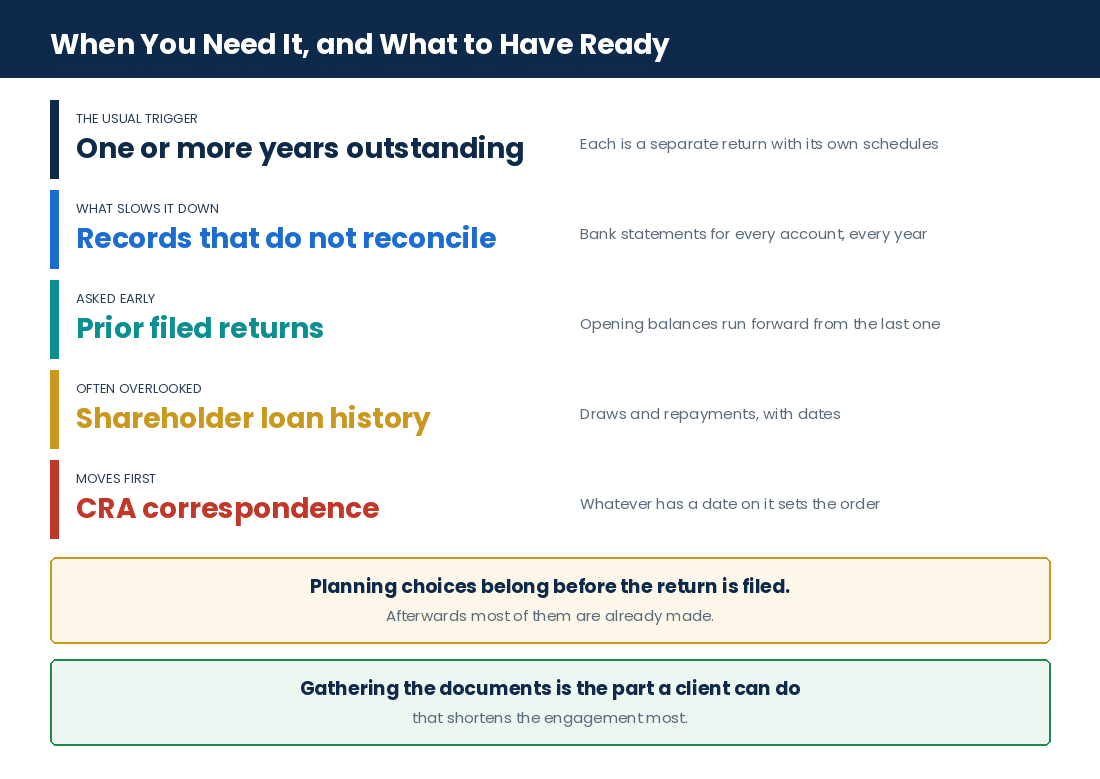
Catch-up corporate tax filing applies in a short list of recognisable situations.
- You missed one or more T2 deadlines.
- CRA sent you a notice about late filings.
- You want to apply for government grants but need current filings.
- You plan to sell or transfer your business soon.
- CRA might audit because of the missing returns.
- You want to stop penalties and interest from piling up.
- Your bookkeeping fell behind and caused the delay.
- Your accountant found missing past filings.
A corporate tax accountant can look at the case and say what to do next. Timelines are worth confirming with a Registered CPA, because CRA rules change often.
| Scenario | What Can Go Wrong | Compliance Point | CPA Role | First Step |
|---|---|---|---|---|
| Missed several T2 deadlines | Penalties and interest grow | Late-filing notices | Prepare and file the old returns | Gather the financial information |
| A formal letter from CRA | Higher chance of audit | Audit trigger | Represent the client in the review | Respond quickly |
| Business sale coming | Closing could be delayed | Due diligence checks | Prepare clean records | Organise the past returns |
| Applying for relief grants | May not qualify without up-to-date status | Verify compliance | Update the filings | Confirm which years are open |
The Issues Late Filers Run Into
- Missing financial records. Lost receipts or statements slow everything down.
- Mixed personal and business expenses. Sorting them out takes time, and wrong figures risk an audit.
- Unreconciled accounts. Differences in the ledgers create errors, so cleanup comes first.
- Multiple years backlogged. More years mean more work, and older data may need updating.
- No supporting documents. Without invoices or contracts, some deductions will not count.
- Earlier mistakes. Past errors may call for corrected returns.
A client with two unfiled years was mid-way through selling his company when the buyer’s lawyer asked for the corporate tax filings. Nothing about the business was wrong; the returns simply had not gone in. The closing slipped by about seven weeks while we prepared both years and reconciled the books behind them, and the buyer held back roughly $25,000 against the unknown tax position until the filings were assessed. Had the returns been current, neither the delay nor the holdback would have existed. Figures changed for privacy.
Documents To Have Ready
| Item | Why Needed | Where To Find It | Common Mistakes | Our Tip |
|---|---|---|---|---|
| Bank statements | Check income and expenses | Online banking | Missing months or dates | Provide every month in full |
| General ledger or trial balance | Summarises the accounts | Accounting software | Out-of-date versions | Use the latest reconciled reports |
| Receipts and invoices | Prove the expenses | Paper and electronic files | Lost documents | Keep digital copies organised |
| Payroll records | Confirm wages | Payroll provider systems | Missing information | Keep payroll up to date |
| Past filed returns | Compare against the new data | Previous submissions | Duplicate entries | Reference the earlier filings |
| Contracts and agreements | Verify deductible expenses | Stored contracts | Disorganised files | Store them in one place |
Working with a CPA firm means the documents get checked and the gaps get named before anything is submitted.
DIY, a Registered CPA Firm, or a Non-CPA Provider
The Choice
Three Routes, and What Each One Actually Gives You
When catch-up filing or corporate tax planning is needed there are three routes: file the returns yourself, engage a Registered CPA firm, or use a non-CPA provider offering business tax services. They differ on compliance accuracy, audit readiness, cost and risk.
| Factor | DIY Filing | CPA Firm | Non-CPA Provider |
|---|---|---|---|
| Compliance accuracy | High risk of mistakes | Expert review keeps it accurate | Can be less reliable |
| CRA audit readiness | Little knowledge of audits | Full preparation and representation | Usually no audit help |
| Tax planning and credit optimisation | None or very little | Plans that can save money | Rarely offered |
| Accountability and transparency | You alone are responsible | Registered professionals are accountable | Less regulated, less clear |
| Cost efficiency | Low upfront, risks later | Clear fees for known work | Lower fees, possible hidden costs |
| Documentation and record keeping | Records may be incomplete | Held to professional standards | Varies by provider |
| Representation before CRA | No | Full support, including voluntary disclosures | No or limited assistance |
The right route depends on how comfortable you are with Canadian corporate tax rules and how much risk you are willing to carry.
Where CRA Audits Come In
Gondaliya CPA represents corporations through CRA audits. We respond to the queries, assemble the documentation CRA asks for, deal with the auditor directly and represent the corporation through to resolution. That is a different thing from performing an audit engagement: we perform compilation engagements under CSRS 4200 and refer audit and review engagements out.
It matters here because audit readiness is the factor that separates the three routes most sharply. A corporation that files its own catch-up returns has nobody to put in front of the auditor, and a non-CPA provider is usually not there either.
A client filed four overdue years himself using online software, then came to us when CRA opened a review of two of them. The returns were not far wrong, but the expenses had been entered in the wrong years and there was no documentation set behind any of it. Assembling the invoices and contracts, explaining the timing differences and dealing with the auditor took longer than preparing all four returns properly would have. The reassessment came to roughly $9,000, most of which was expenses disallowed for want of paperwork rather than expenses that were not real. Figures changed for privacy.
Catch-Up Readiness Check
Five quick questions on how ready your records are. No fee shown.
Points to raise with us:
This is a general prompt, not tax or legal advice or a quote. Your position depends on your full facts. For a real review, please book a free consultation.
How the Work Runs at Gondaliya CPA
Process
Six Phases, From the First Call to the Planning That Follows
Gondaliya CPA handles catch-up corporate tax filing for incorporated small and medium businesses across Canada. The work moves quickly and still meets CRA requirements, and we cover every step: the first conversation, collecting the documents, preparing the returns, filing them, handling any CRA follow-up, and planning for next time.
| Phase | What You Do | What We Do | Notes |
|---|---|---|---|
| Intake and consultation | Share the basic information and your goals | Review the case and explain the steps | Service agreement signed |
| Document and data collection | Gather bank statements, invoices and the rest | Check promptly for anything missing | We give you a checklist |
| Preparation and review | Answer questions quickly | Prepare the T2 returns and the reports | You get draft reports |
| Filing and approval | Approve the final return | File electronically | You get confirmation of filing |
| CRA follow-ups and representation | Reply fast if CRA contacts you | Handle all the communication | Issues resolved quickly |
| Ongoing support and planning | Schedule check-ins | Plan for the future tax years | Tax updates provided |
Run this way, the surprises stay low and compliance stays high while the filings are caught up. Fees are fixed and annual with no hourly billing, shown before tax with sales tax on its own line, and agreed before any work begins; the pricing calculator gives a figure in about two minutes.
What We Need From You
- Prior years’ financial statements, where you have them
- Bank and credit card statements for the years involved
- Invoices and receipts for business expenses
- Payroll records, if you have employees
- Details of any assets bought or sold
- Information on loans or financing
Having these ready speeds up intake and removes most of the questions that would otherwise come later.
Two clients started catch-up engagements in the same week, both three years behind. One sent bank statements, invoices and a payroll export on the day we opened the file. The other sent documents as we asked for them, one request at a time, over two months. The returns were comparable. The first engagement was filed in nine days; the second took eleven weeks, almost all of it waiting. Because the fee is fixed and annual rather than hourly, the waiting cost the second client the planning window rather than money: by the time he was current, two of the moves we had identified could only start in the following year. Figures changed for privacy.
Deliverables and What You Get
Deliverables
Five Things That Come Out of a Catch-Up Engagement
A catch-up engagement produces documents, not reassurance. These are the five, and what each one is for.
- Filed T2 returns. The main deliverable is preparing and filing the late T2 corporate income tax returns. Correct returns go to CRA for every missed year, which is what stops bigger penalties and interest from building up.
- Financial statement reconciliation reports. Reconciled statements show the true state of the company’s money, with every transaction matched to the bank records and to accounting software such as QuickBooks or Xero. The reports are useful for business decisions as well as for the returns.
- Voluntary Disclosure Program application. Where missed filings carry penalties or risk, CRA’s Voluntary Disclosure Program can cut or remove the fines. We prepare the application as part of the catch-up work and the planning that goes with it.
- Penalty and interest assessment review. We go over any penalty notices or interest charges CRA has raised for the late filings. Knowing those figures is what lets you decide whether voluntary disclosure is the right route or whether another fix suits the position better.
- CRA representation. When back taxes or an audit arise from the late filings, we handle the communication with CRA, which takes the pressure off you and protects the corporation through the review.
| Deliverable | Description | Who Uses It | When Delivered | Client Input Needed |
|---|---|---|---|---|
| Filed T2 corporate tax returns | Submission of the overdue federal and provincial returns | Business owners and CRA | After data collection and review | Financial records and prior year information |
| Financial statement reconciliation reports | Verified account balances aligned with the bank data | Management and the CPA | Before the returns are finalised | Bank statements and transaction logs |
| VDP application | Formal request for penalty relief through voluntary disclosure | Businesses facing penalties | As needed during the catch-up | Complete history of the unfiled periods |
| Penalty and interest review | Analysis of the fees assessed on the late filing | Business owners | After filing | The notices received from CRA |
| CRA representation | Handling communications and audits with the agency | Businesses under audit | Throughout the engagement | Authorisation documents |
The Rest of What We Do Alongside It
- Catch-up filing for overdue corporate taxes, handled start to finish
- A transparent fee structure, with the price clear upfront
- Payroll system reviews using Wagepoint, ADP and similar platforms
- Tax credit optimisation, including SR&ED claims
- Bookkeeping reconciliation with QuickBooks and Xero
- Voluntary Disclosure Program applications to reduce penalties
- Penalty and interest assessment reports, for full cost clarity
- Multi-entity filings, with intercompany accuracy as the focus
- Audit defence and CRA penalty negotiation support
- Clear communication throughout the tax cleanup
- Business tax services, including GST/HST filing synchronisation
- Incorporation and restructuring advice for tax purposes
- Personal tax filing that complements the corporate returns
A client assumed the penalty notices CRA had sent him were final figures and had been budgeting for them for a year. Going through the penalty and interest assessment review was the first time anyone had added them up properly, and two of the charges related to a year that had in fact been filed. The Voluntary Disclosure Program application covered the rest. What he actually paid was roughly $13,000 below the number he had been carrying in his head, and the review that found it took half a day. Figures changed for privacy.
What Drives the Cost, the Risks and the Mistakes
Cost & Risk
Why Two Catch-Up Files of the Same Size Cost Different Amounts
The price of filing old corporate taxes turns on the situation rather than on a flat rate. Six things move it.
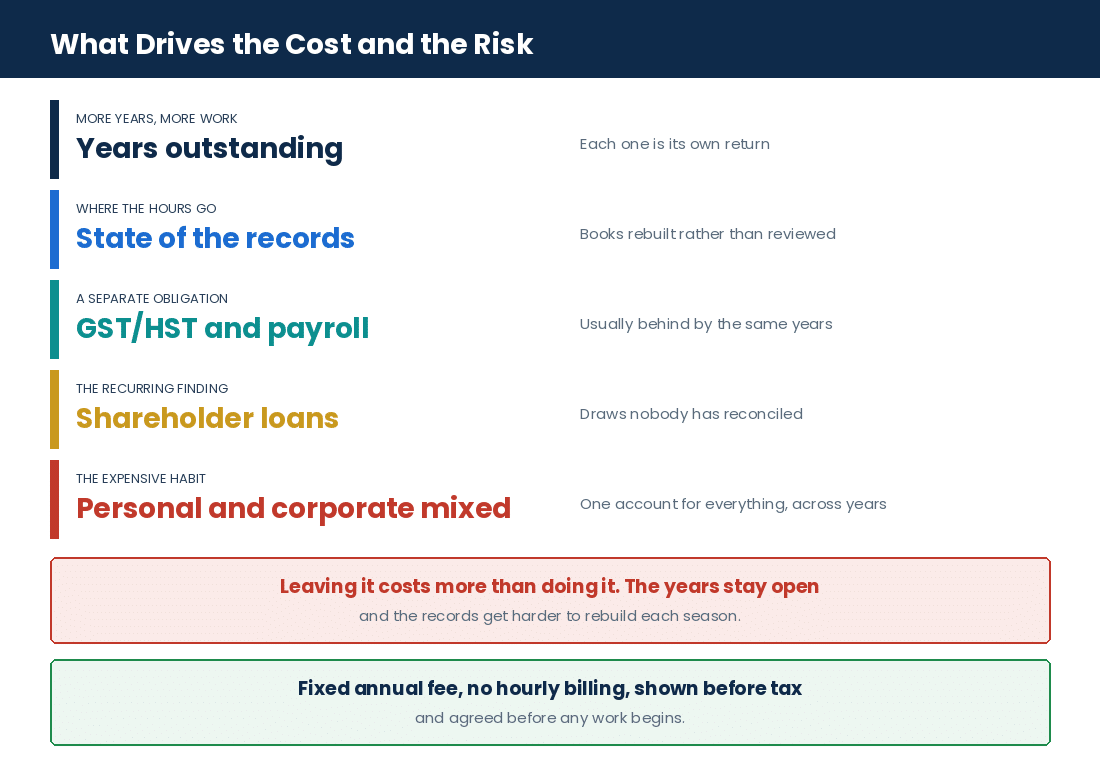
- Number of years unfiled. More years means more work.
- Volume and complexity of transactions. A high transaction count takes longer, and multiple income types or foreign dealings make it harder.
- Entities involved. Several corporations or trusts add complexity.
- Condition of the records. Organised data costs less; messy accounts need more time.
- Need for record reconstruction. Missing papers mean rebuilding the data by hand.
- Depth of advisory and urgency. Filing alone differs from filing plus full planning, and a tight deadline costs more.
| Driver | Impact on Cost | How To Keep It Efficient | Questions To Ask Your CPA Firm |
|---|---|---|---|
| Number of years unfiled | More years, higher fee, on volume alone | Prioritise the earliest years where you can | How many years need filing, and can it be done in parts? |
| Complexity of the business | Complex structures need extra analysis | Disclose every entity at the outset | Do you handle multi-company setups? |
| Condition of the records | Disorganised or missing documents add preparation time | Reconcile what books exist first | Are my books reconciled and up to date? |
| Need for record reconstruction | Manual rebuilds add hours | Download statements for every account and year | Will missing receipts delay completion? |
| Need for a VDP application | Adds paperwork, reduces penalty risk | Decide on it early rather than late | Is voluntary disclosure advisable here? |
| Depth of planning required | More advice adds to the cost | Separate the filing scope from the planning scope | What does the planning work cover? |
Talking about these openly is what sets fair expectations before the work starts, because every case is different. Fees here are fixed and annual with no hourly billing, shown before tax with sales tax on its own line. Where a balance cannot be paid at once, the payment arrangement calculator shows what a monthly figure would look like.
A client quoted us against a provider who had priced three years of catch-up filing at about a third of our fee. The quote assumed books that reconciled. They did not: two of the three years had never been closed, and the general ledger did not agree with the bank by roughly $70,000 of unexplained transfers. Reconstruction was the work, and the other provider’s price did not include it. He came back four months later having paid twice, once for a set of returns that had to be redone. Scope the bookkeeping before comparing fees. Figures changed for privacy.
The Risks of Leaving It
Filing corporate taxes late causes problems under Canadian law. The fines grow over time, with interest added daily, and poor records invite audits that cost time and money. Handling an audit well takes experience.
- Late-filing penalties that grow fast
- Interest charges increasing the debt daily
- A greater likelihood of being audited
- Missed deductions making the tax higher
- Errors that can lead to investigations
- Weak documentation hurting your position in a dispute
- Provincial rules not followed, causing further issues
| Risk Area | What Happens If Missed | What We Do About It | Who Is Affected |
|---|---|---|---|
| Late-filing penalties | Fines grow monthly and scrutiny rises | Timely filings and voluntary disclosures | Incorporated SMBs |
| Interest accrual | Debt rises daily until paid | Correct calculations and a payment plan | Businesses owing taxes |
| Audit trigger | The chance of a review rises automatically | Prepared responses, documentation and representation | Late filers |
| Incomplete or inaccurate returns | Reassessments and a higher audit chance | Careful review and quality checks | Business owners |
| Payroll remittance errors | Interest and possible penalties | Exact payroll tracking and cleanup | Employers with staff |
| Missed credits and deductions | Lost savings raise the amount payable | Regular checks for available credits | Clients wanting savings |
| Documentation gaps | Lack of evidence causes reassessments | Systematic record-keeping advice | All taxpayers |
A Registered professional checks the documents carefully and keeps up with the rules as they change, which cuts errors and means the filings hold up if they are reviewed. Payroll remittance errors on CPP, EI and income tax withheld are a frequent cause of interest owing later, and clean bookkeeping is what prevents most of the rest.
The Mistakes That Cost the Most
- Mixing personal and business expenses, which distorts the reporting and takes time to unpick.
- Missing eligible deductions, which lowers the savings the catch-up could have produced.
- Not tracking assets correctly, which affects what can be claimed.
- Forgetting province-specific rules, which leaves the forms incomplete.
- Sending partial information, which triggers delays and more questions.
- Payroll remittance calculation errors, which mean underpaying and owing interest later.
Before You Start
- Collect the prior years’ financial statements, which give the history the new reports are built on
- Clean up the bookkeeping so every transaction matches the bank records
- Bring the payroll remittances current, because CRA flags mistakes there quickly in a review
- Keep business and personal accounts separate from here on
- Use a checklist for the documents rather than sending them as they surface
- Use the sync tools between your bank and your bookkeeping software, which is what stops documents going missing
- Raise your open questions early, which cuts the back-and-forth later
A restaurant client had run payroll for four staff through a spreadsheet for two years while the corporate returns went unfiled. The remittances were short in most months, never by much. Reconstructing the payroll and bringing the remittances current added roughly $8,000 of interest and penalty to a file whose corporate tax, once calculated, was modest. The payroll was the expensive part, and it was the part nobody had mentioned at intake. Tell your accountant about the payroll on day one. Figures changed for privacy.
Frequently Asked Questions
FAQs
Frequently Asked Questions on Overdue Corporate Returns and Tax Planning
What is the Voluntary Disclosure Program, and how do you help with it?+
The Voluntary Disclosure Program lets a business correct past tax errors with reduced penalties. We guide clients through the application for penalty relief and make sure what goes to CRA is accurate and complete, as part of the catch-up filing rather than as a separate exercise.
How do you deal with payroll remittance errors?+
We review payroll systems such as Wagepoint and ADP to find the remittance errors, then correct them before the returns are filed, which is what keeps CRA penalties and interest charges off the file. Errors on CPP, EI and income tax withheld are the usual culprits.
Can you handle multi-entity tax filing?+
Yes. We file for corporations with multiple entities and make sure the intercompany transactions are reported correctly, which is what prevents the errors and audit attention that otherwise follow a group filing. Disclose every entity at the outset rather than one at a time.
What penalty mitigation strategies do you use?+
Voluntary disclosure, penalty negotiation and accurate catch-up filing, used together according to what the position supports. Alongside that you get plain communication about the risks and the steps involved, so the decision is yours and made on figures rather than on guesswork.
How does bookkeeping cleanup support corporate tax filing?+
Clean bookkeeping is what makes the data accurate. Using tools such as QuickBooks, Xero or Hubdoc, we reconcile the accounts so the T2 returns and the GST/HST filings are error-free. On most catch-up files the cleanup is the bulk of the work, not the tax preparation.
Do you provide CRA representation during audits?+
Yes. We represent clients through CRA reviews: responding to the queries, assembling the documentation, dealing with the auditor directly and negotiating the resolution. That is distinct from performing an audit engagement, which we do not do — we perform compilation engagements under CSRS 4200 and refer audit and review engagements out.
What exactly does catch-up corporate tax filing cover?+
Preparing the overdue T2 returns, reviewing the past bookkeeping, calculating the tax owed or the refund due, and submitting the returns to CRA, which is usually done online. Representation on CRA questions is optional and added where the position calls for it. Planning for future years sits outside the catch-up scope and is handled under corporate tax planning.
Is this service right for a sole proprietor?+
No. It is built for incorporated small and medium businesses with overdue corporate taxes, for owners who want to plan ahead and pay less tax later, and for companies that need a corporate tax accountant. Sole proprietors who are not incorporated do not need corporate services, and neither does a business that is already up to date with nothing coming.
What documents should I have ready before we start?+
Bank and credit card statements for the years involved, the general ledger or trial balance from your accounting software, receipts and invoices, payroll records if you have employees, any returns already filed, and the contracts behind your larger deductible expenses. Also bring details of assets bought or sold and information on any loans or financing.
What makes one catch-up engagement cost more than another?+
Six things: the number of years unfiled, the volume and complexity of the transactions, the number of entities involved, the condition of the records, whether missing records have to be reconstructed, and the depth of advisory work wanted. Urgency moves it too. Fees are fixed and annual with no hourly billing, shown before tax with sales tax on its own line, and agreed before any work begins.
Essential Points for Business Owners
Key Takeaways
What Decides How a Catch-Up File Goes
The filings themselves are routine. What varies is the state of the records, how much was disclosed at the start, and whether the planning questions were settled while the catch-up work was still open.
| Point | What It Means |
|---|---|
| Catch-up filing | Sending CRA the overdue T2 returns so the corporation’s tax record is current |
| Corporate tax planning | Lowering what the years ahead cost, which is separate work from the catch-up |
| Who it fits | Incorporated small and medium businesses, not unincorporated sole proprietors |
| What triggers it | Missed deadlines, a CRA notice, a grant application, a sale, or an audit risk |
| The core deliverables | Filed T2s, reconciliation reports, VDP application, penalty review, representation |
| The cost drivers | Years unfiled, transaction volume, entities, record condition, reconstruction, advisory depth |
| The main risks | Penalties growing, daily interest, audit exposure, missed deductions, weak documentation |
| The common mistakes | Mixed personal and business expenses, partial information, payroll errors, provincial rules missed |
| Penalty relief | The Voluntary Disclosure Program, penalty negotiation and accurate catch-up filing |
| CRA audits | We respond to queries, assemble documentation, deal with the auditor and represent you |
| Assurance scope | Compilation engagements under CSRS 4200 only; audit and review engagements referred out |
| Fees | Fixed and annual with no hourly billing, before tax with sales tax on its own line |
The Six Things We Check First
- How many years are actually outstanding? Owners are often wrong about the count in both directions, and the scope follows from the answer.
- Do the books reconcile to the bank? Where they do not, bookkeeping cleanup is the engagement and the tax preparation is the short part at the end.
- Is there more than one entity? Intercompany transactions have to agree, and finding a second corporation halfway through costs more than disclosing it at intake.
- What is the payroll position? Remittances are usually behind by the same years, and they carry their own interest and penalties.
- Has CRA written? A notice or a review changes the order of the work and brings representation into scope straight away.
- Which planning moves depend on the unfiled years? Those are settled while the catch-up is open, because doing them afterwards means doing some of them twice.
Our Approach
Gondaliya CPA scopes the years outstanding and the state of the records before quoting, so the fee reflects the real work; reviews the past bookkeeping and reconciles it to the bank data before preparing anything; prepares and files the overdue T2 returns electronically with confirmation of filing; reviews the penalty and interest notices so the balance is a known figure rather than a fear; applies to the Voluntary Disclosure Program where the position supports it; brings the payroll remittances and GST/HST current alongside the returns; represents the corporation through CRA queries and audits, including assembling the documentation and dealing with the auditor; and sets up the corporate tax planning for the years ahead once the record is current. Financial statements are prepared under compilation engagements in accordance with CSRS 4200, which provide no assurance, and audit and review engagements are referred out. Fees are fixed and annual with no hourly billing, shown before tax with sales tax on its own line, and agreed before any work begins.
Industry Spotlights: Sectors We Represent
Industry Expertise
Catch-up filing and corporate tax planning land differently in each sector. Here are eleven, and what each one needs most.
| Industry | Primary Service Focus and Why It Matters |
|---|---|
| Technology startups & SaaS | Tax credit optimisation, including SR&ED claims, once the books reconcile |
| E-commerce & online retailers | Bookkeeping reconciliation and GST/HST filing synchronisation |
| Consulting firms | Separating personal from business spending before the returns are prepared |
| Construction, contractors & skilled trades | Corporate accounting plus catch-up filing, with job-cost tracking behind it |
| Property developers & builders | Catch-up filing plus business tax services, recorded by project phase |
| Real estate investors & holding companies | Catch-up filing plus planning, using holding company deductions |
| Transportation, logistics & trucking | Asset and vehicle records tracked properly so the claims hold up |
| Restaurants & food and beverage | Payroll remittance cleanup alongside the overdue returns |
| Daycare, childcare & CWELCC services | Business tax services, tracking subsidies against deductible expenses |
| Dentists & dental practices | Equipment depreciation tracked, with RCDSO expenses and GST/HST filings correct |
| Medical doctors & physician corporations | Corporate tax planning around income splitting, retirement savings and OHIP billings |
- Technology startups & SaaS: Credit optimisation, SR&ED claims included, only works once the books have been reconciled for each of the unfiled years.
- E-commerce & online retailers: High transaction volume is what drives the cost here, and GST/HST filings have to be synchronised with the corporate returns rather than handled separately.
- Consulting firms: Personal and business expenses run through one account is the commonest pattern we see, and sorting it out is most of the work before anything can be filed.
- Construction, contractors & skilled trades: Contract income varies and staffing moves with the season, so instalment payments have to be set accurately to avoid a surprise at year end.
- Property developers & builders: Project delays push back the accounting closeout and cause the late filings, so revenue and costs are recorded by project phase and progress billings are kept separate.
- Real estate investors & holding companies: Many property deals or rentals across provinces are what put investors behind, and planning lowers the tax through deductions such as mortgage interest and property taxes inside the holding company.
- Transportation, logistics & trucking: Assets bought and sold have to be tracked correctly across the unfiled years, because that is what the claims rest on when the returns are reviewed.
- Restaurants & food and beverage: Payroll for hourly staff is usually behind by the same years as the returns, and the remittance errors carry interest and penalties of their own.
- Daycare, childcare & CWELCC services: Government subsidies are tracked alongside operating costs, and deductible expenses such as building repairs or teaching materials are claimed without putting the subsidy at risk.
- Dentists & dental practices: Equipment depreciation, RCDSO expenses and the GST/HST filings all need to be right, and planning is what manages the cash flow around an expensive purchase.
- Medical doctors & physician corporations: Income splitting, retirement savings and medical expense claims are the planning levers, with deductions for OHIP billings and office costs claimed inside the CRA rules.
A dental practice came to us two years behind, having bought roughly $180,000 of chairside equipment in the first of those years. Nobody had tracked the assets, so the depreciation had never been claimed and the purchase sat in the accounts as a lump of unexplained spending. Reconstructing it from the supplier invoices changed the taxable income in both years. The planning conversation that followed was about timing the next purchase rather than about the tax on the last one. Figures changed for privacy.
Professional Guidance and Quick Reference
Guidance
Essential Points for Toronto and Canadian Corporations
Catch-up files go wrong in a predictable set of ways: bookkeeping that was never reconciled, so the returns are built on figures that do not agree with the bank; personal and business spending run through one account across several years; payroll remittances left out of the conversation at intake and discovered after the T2s are drafted; a second corporation disclosed halfway through; documents sent one at a time as they surface rather than against a checklist; and planning moves left until the catch-up is finished, when some of them have to be done twice. Gondaliya CPA scopes the records before quoting and settles the planning questions while the filings are still open.
Quick Answers
At a Glance
- What catch-up filing is: sending CRA the overdue T2 returns a corporation missed
- What it fixes: the tax record of a business that skipped deadlines
- What it heads off: penalties, interest and audit attention from late filings
- What it includes: preparing the returns and reviewing the past bookkeeping
- Also included: calculating the tax owed or the refund due
- Filing method: submitted to CRA, usually online
- Optional: representation on CRA questions, reviews and audits
- Excluded: planning for future years, handled under corporate tax planning
- Who it fits: incorporated small and medium businesses with overdue corporate taxes
- Who it does not fit: unincorporated sole proprietors
- The triggers: a missed deadline, a CRA notice, a grant application, a sale, an audit risk
- Documents first: bank statements, ledger or trial balance, receipts, payroll, past returns, contracts
- The process: six phases, intake through ongoing support and planning
- The deliverables: filed T2s, reconciliation reports, VDP application, penalty review, representation
- Penalty relief: the Voluntary Disclosure Program can cut or remove the fines
- Penalty negotiation: used alongside voluntary disclosure and accurate catch-up filing
- Bookkeeping tools: QuickBooks, Xero and Hubdoc
- Payroll platforms: Wagepoint, ADP and similar systems
- Credits: tax credit optimisation, SR&ED claims included
- Groups: multi-entity filings, with intercompany accuracy as the focus
- Alongside the T2s: GST/HST filing synchronisation
- Cost driver one: the number of years unfiled
- Cost driver two: the volume and complexity of the transactions
- Cost driver three: the entities involved
- Cost driver four: the condition of the records
- Cost driver five: whether records have to be reconstructed
- Cost driver six: the depth of advisory work, and urgency
- CRA audits: we respond, assemble the documentation and deal with the auditor
- Assurance scope: compilation engagements under CSRS 4200 only
- Fees: fixed and annual, no hourly billing, sales tax on its own line
Who This Is For / Not For
Fit Check
- For: incorporated small and medium businesses with overdue corporate taxes, whatever the number of years.
- For: business owners who want to plan ahead and pay less tax later, and companies that need a corporate tax accountant for the complex rules.
- Not for: sole proprietors without incorporation, who do not need corporate services.
- Not for: businesses that are up to date and have no tax issues coming.
People Also Ask
Related Questions
Can I file the overdue returns myself?+
You can, and the upfront cost is low, but the risk sits with you. Filing yourself carries a high chance of mistakes, little knowledge of how audits work, no planning or credit optimisation, and records that may be incomplete. The choice turns on how comfortable you are with Canadian corporate tax rules and how much risk you want to carry. Where a return is wrong, the cost of correcting it usually exceeds what the fee would have been.
Can catch-up filing and tax planning be done together?+
They are separate services and they work well in one engagement. Catch-up filing deals with the taxes already missed; planning deals with the years ahead. Combining them is worth doing because some planning moves depend on figures that only settle once the earlier years are filed, and making those moves before the catch-up is complete can mean making them twice.
My bookkeeping is a mess. Does that stop us starting?+
No, but it is the thing that decides the cost and the timeline. Unreconciled accounts, lost receipts, mixed personal and business spending and several backlogged years all mean cleanup before the returns can be prepared. Reconciling what books exist against the bank statements first, or saying plainly that they do not reconcile, is the single most useful thing a client can do before intake.
CRA has already sent me a notice. What changes?+
The order of the work, and the urgency. A formal letter raises the chance of a review, so responding quickly comes before anything else, and representation moves into scope at the start rather than at the end. We deal with the correspondence, assemble what CRA asks for and handle the auditor directly. Bring every letter you have received to the first conversation.
Do you perform audits of my financial statements?+
No. We perform compilation engagements under CSRS 4200, which provide no assurance, and we refer audit and review engagements out. Helping a client through a CRA audit is a different matter entirely, and we do that: responding to the queries, assembling the documentation, dealing with the auditor and representing the corporation to resolution.
Glossary of Key Terms
Definitions
- T2 return: the corporate income tax return filed with CRA for each tax year.
- Catch-up corporate tax filing: preparing and submitting the overdue T2 returns a corporation missed.
- Corporate tax planning: strategies that lower what a corporation owes in future years.
- Voluntary Disclosure Program: CRA’s route to correcting past errors with reduced penalties.
- Penalty and interest assessment review: an analysis of the charges CRA has raised on the late filings.
- CRA representation: handling the communications, reviews and audits on the corporation’s behalf.
- Financial statement reconciliation: matching every transaction to the bank records and the accounting software.
- Bookkeeping cleanup: correcting and reconciling the accounts before the returns are prepared.
- General ledger and trial balance: the summary of the accounts, taken from the accounting software.
- Payroll remittance: the CPP, EI and income tax withheld and sent to CRA for employees.
- Multi-entity filing: returns for a group of corporations, with intercompany transactions reconciled.
- GST/HST synchronisation: bringing the sales tax filings into line with the corporate returns.
- SR&ED: a tax credit claim included in credit optimisation work.
- Compilation engagement: financial statements prepared under CSRS 4200, which provide no assurance.
Want a checklist to work from? You can download our free overdue returns and planning checklist before your consultation.
Four things decide how a catch-up file goes. Whether the bookkeeping is reconciled before the returns are prepared — unreconciled accounts, lost receipts and mixed personal and business spending are the bulk of the work on most files, and the tax preparation is the short part at the end. Whether everything outstanding is disclosed at intake — a second corporation, payroll remittances behind by the same years, GST/HST filings not synchronised, all of it is cheaper handled in one engagement than discovered after the T2s are drafted. Whether the penalty position is actually calculated — the notices are added up, voluntary disclosure is assessed against them, and the balance becomes a known figure instead of something to budget around. And whether the planning questions are settled while the catch-up is still open — some moves depend on figures that only settle once the earlier years are filed, and leaving them to the end means doing part of the work twice.
Three questions settle what you are dealing with, and none of them needs the books finished. First, how many years are actually outstanding, and has CRA written about any of them? The letters tell you, and the answer sets the order of the work. Second, do your accounts reconcile to the bank for those years? If they do not, say so plainly; it changes the scope, not the willingness to take it on. Third, is the payroll current, and is there more than one corporation? Those two are the items most often left out at intake and most expensive to find later.
Overdue Corporate Tax Returns: How Gondaliya CPA Can Help
File the missed years, then plan the next ones
Gondaliya CPA scopes the years outstanding and the condition of the records before quoting, reviews and reconciles the past bookkeeping against the bank data, prepares and files every overdue T2 return electronically with confirmation, delivers the financial statement reconciliation reports behind them, reviews the penalty and interest notices so the balance is a known figure, prepares a Voluntary Disclosure Program application where the position supports it, brings the payroll remittances and the GST/HST filings current alongside the returns, represents the corporation through CRA queries and audits including assembling the documentation and dealing with the auditor, and sets up the corporate tax planning for the years ahead once the record is current. Financial statements are prepared under compilation engagements in accordance with CSRS 4200, which provide no assurance. Fees are fixed and annual with no hourly billing, shown before tax with sales tax on its own line, and agreed before any work begins. Please book a free consultation.
Next Steps
Please book a free consultation with Gondaliya CPA and bring three things: a list of the years you believe are outstanding, whatever bank statements and ledgers you can produce today, and every piece of CRA correspondence you have received. We will confirm the scope against the records rather than working from recollection, and the first conversation is usually shorter than owners expect. If you have employees, say so at the outset, because payroll remittances are normally behind by the same years and carry their own interest and penalties. If a second corporation or a trust is involved, mention that too; intercompany transactions have to agree, and finding the second entity halfway through is the commonest reason a catch-up engagement runs long. We perform compilation engagements under CSRS 4200, which provide no assurance, and we refer audit and review engagements out; helping clients through CRA audits is separate work that we do. You will get a fixed annual fee, shown before tax, agreed before any work begins. We serve Toronto, Mississauga, Brampton, Vaughan, Etobicoke, Scarborough, Hamilton, Ottawa and the rest of Ontario, and work with corporations across Canada. If our content helps, please add gondaliyacpa.ca as a preferred source on Google.
Published: · Last updated:
Editorial policy: We research against the Income Tax Act, the Income Tax Regulations, CRA guidance and information circulars, Department of Finance announcements, CPA Canada Handbook standards and CPA Ontario sources, fact-check the figures, and Sharad Gondaliya, CPA, reviews the content, which we update as the rules change.
Disclaimer: This article is educational information only and is not tax, legal or accounting advice. It covers catch-up corporate tax filing and corporate tax planning for incorporated small and medium businesses in Toronto, Ontario and across Canada, including what catch-up filing includes and excludes, the situations that trigger it, the documents to prepare, the choice between filing yourself, a Registered CPA firm and a non-CPA provider, the engagement process and timeline, the deliverables, the Voluntary Disclosure Program, penalty and interest assessment reviews, CRA representation, the cost drivers, the risks and common mistakes, and how the work applies across the sectors we represent. It does not cover penalty or interest rates, provincial corporate filing rules outside Ontario, or the filing obligations of unincorporated businesses. Rules, forms and thresholds change, and every reference should be confirmed against current CRA guidance and the current Income Tax Act. Whether CRA grants penalty relief in any particular case is discretionary and turns on the facts and the evidence presented. Gondaliya CPA performs compilation engagements under CSRS 4200, which provide no assurance, and does not perform audit or review engagements; representing clients through CRA audits is separate work that the firm does provide. Please consult a licensed CPA before acting.

Sharad Gondaliya is a CPA Canada & CPA USA with 15 Years+ experience of Accounting, Tax, Payroll of Corporate Small Businesses as Tax Accountant. He is a CPA Ontario member (61040184) and holds US CPA licences in Washington and Montana and is well known among corporate small businesses for tax planning, efficient tax solutions, and affordable CPA services. Sharad is the Principal (Director) of Gondaliya CPA – Affordable CPA Firm in Canada. Licenses: CPA Ontario: 61040184 | CPA USA (MT): PAC-CPAP-LIC-033176 | CPA USA (WA): 57629 | CPA Firm License: 61330051 View Full Author Bio