



The Ultimate Guide to Accounting and Tax Services for Landscaping Companies in Canada
Landscaping Company Accountant Canada: Expert Landscaping Accounting Services and Tax Support by Gondaliya CPA
If you’re looking for a reliable landscaping company accountant Canada, Gondaliya CPA offers expert landscaping accounting services and tax support tailored for horticultural and landscaping businesses. Our team focuses on providing clear landscaping tax accountant guidance to help your company manage finances and stay compliant across Canada.
Reading time: 52 minutes.
Table of Contents
- Accounting Services for Landscaping and Horticultural Businesses Across Canada
- Core Accounting and Tax Services for Landscaping Companies
- Addressing Common Accounting Challenges for Landscaping Companies
- Starting a Landscaping Business: Essential Accounting and Legal Steps
- Serving Landscaping Companies in Burlington, Oakville, Hamilton, and Beyond
- Resources to Support Landscaping Accounting Success
- Frequently Asked Questions (FAQs) About Landscaping Company Accounting in Canada
- Key Points at a Glance: Essential Tax and Accounting Deadlines for Landscaping Companies
- Quick Comparison Table: DIY vs CPA vs Non-CPA Providers for Landscaping Accounting
- People Also Ask
The Numbers That Matter
This article covers Canada, with Ontario and Toronto context, and reflects rules current to 2026. It applies to incorporated landscaping companies including lawn maintenance contractors, design-build and hardscaping firms, tree care operators, irrigation installers, nursery retailers and snow removal divisions. Figures marked illustrative are examples, not quotes, and any masked engagement notes end with “Figures changed for privacy.” This is educational information only and not tax or legal advice. Municipal licensing, pesticide certification, WSIB classification and horticultural trade qualifications sit outside accounting scope.
Accounting Services for Landscaping and Horticultural Businesses Across Canada
Accounting Services for Landscaping and Horticultural Businesses Across Canada
The Services
Landscaping companies in Canada often deal with money matters that need special attention. A landscaping company accountant in Canada knows the ins and outs of this field. They offer help that fits the unique needs of these businesses. From keeping records to handling taxes, these experts make sure companies follow Canadian laws and keep their money matters clear.
Here are some key services landscaping company CPAs provide:
- Bookkeeping: Keeping detailed records helps track what’s spent and earned. Landscaping accounting services cover everything from buying equipment to paying subcontractors and managing seasonal contracts.
- Tax Preparation: A landscaping tax accountant makes sure businesses follow both federal and provincial tax rules. They also find ways to save money through deductions allowed by law.
- Financial Reporting: Regular financial statements show owners how their cash is flowing. This helps them make smart choices about spending or growing their business.
- Payroll Management: Handling payroll source deduction remittances correctly avoids fines from the CRA (Canada Revenue Agency). It’s important to properly classify who is an employee and who is a subcontractor.
- Advice on Capital Cost Allowance (CCA): Knowing how to depreciate equipment can save big on taxes over time.
When landscaping businesses use these services, they can focus more on growing while keeping their finances in order.
Unique Financial Considerations in the Landscaping and Horticulture Industry
This industry has some specific money-related issues that need care:
- Seasonal Cash Flow: Income goes up and down with the seasons. Spring and summer bring more work, but winter often means less, except maybe snow removal jobs.
- Equipment Depreciation: Landscaping needs a lot of machines like mowers, trucks, and trailers. Using CCA lets companies reduce taxable income by spreading out equipment costs over time.
- Payroll Source Deduction Remittance: Paying payroll taxes on time matters a lot. If a company falls behind, the CRA can charge heavy fines.
- Subcontractor Payments: Paying subcontractors can get tricky. Reporting payments correctly with T5018 slips is required when construction-type work is done.
Because of these points, having a CPA who knows about landscaping accounting services is smart for any business in this field across Canada.
Seasonal cash flow, equipment depreciation, payroll remittance and subcontractor slips are the four items above, and they are the four we open every landscaping file with. Figures changed for privacy.
Core Accounting and Tax Services for Landscaping Companies
Core Accounting and Tax Services for Landscaping Companies
The Core Work
Landscaping companies need accounting help that fits their specific needs. A landscaping company accountant Canada knows the ups and downs of the business. They get how cash flows, seasonal workers, and equipment affect the books. A landscaping company CPA Canada helps keep your taxes right and makes bookkeeping easier for landscape contractors.
Comprehensive Accounting Solutions for Landscaping Businesses
Bookkeeping for landscaping companies means tracking all income from jobs like lawn care, new installations, snow removal, and selling materials. Payroll services for landscapers must handle changing staff sizes during busy seasons. They also follow rules about deductions and payment deadlines.
Corporate tax filing for landscapers involves reporting income carefully. The CRA has rules about when to report money received ahead of time. Financial reporting landscaping companies use often includes job costing reports. These show hours worked by crews, materials used, costs for subcontractors, and equipment wear per job.
This data helps figure out which services make money—like residential lawn care vs. commercial maintenance—and guides business choices.
A good landscaping accounting service uses cloud tools with receipt scanners to keep things smooth year-round. Monthly checks make sure GST/HST filings match real sales and purchases. That lowers audit risks.
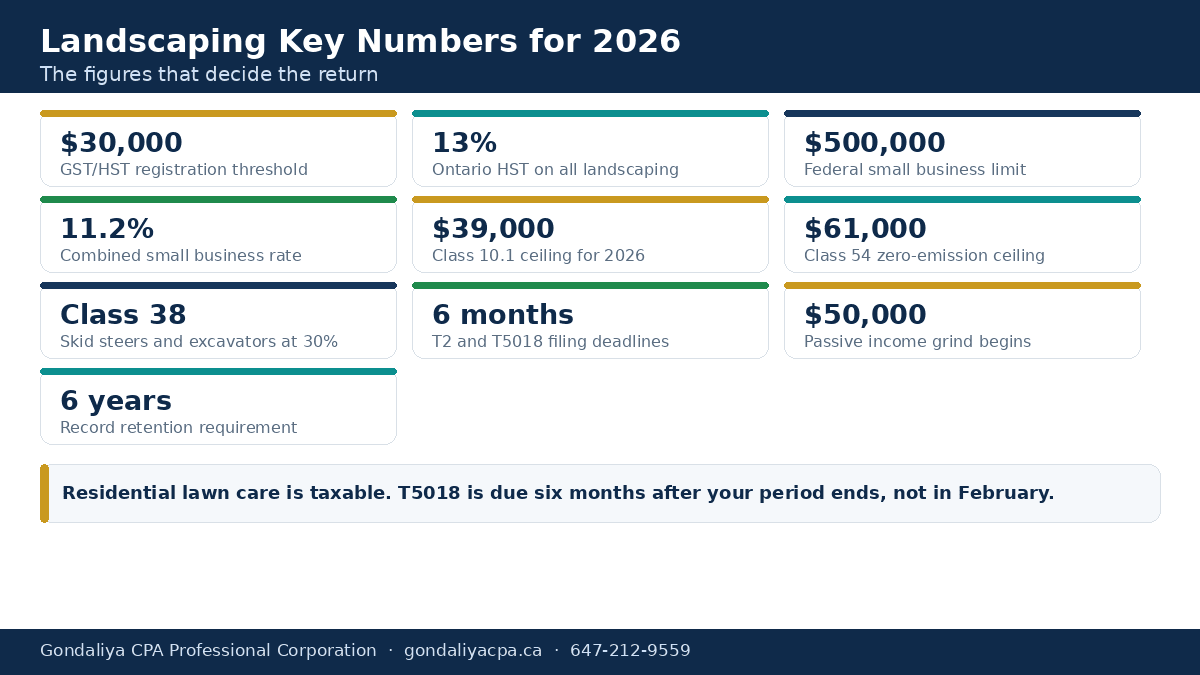
The Class 10.1 capital cost ceiling is $39,000 before tax for 2026, up from $38,000 in 2025, with the Class 54 zero-emission ceiling at $61,000.
Key tasks in accounting include:
- Tracking revenue from different services
- Managing seasonal payroll changes
- Preparing corporate tax returns with correct income recognition
- Creating detailed job costing reports
- Using cloud software to automate record keeping
- Monthly bank reconciliations and GST/HST accuracy
Specialized Tax Planning and Compliance for Landscape Contractors
GST/HST filing landscaping services requires careful work. Input tax credits landscaping equipment claims need proper invoices proving purchases or rentals tied to business use. If assets are partly personal, only part of the credit applies.
Corporate tax planning landscape contractors use focuses on capital cost allowance (CCA). Different equipment falls under various CCA classes—mowers in Class 8, trailers in Class 10, skid steers in Class 38—and recent rules let some expenses be written off immediately starting 2026. Using the half-year rule right avoids claiming too much too soon. Also, selling equipment can cause recapture income if handled wrong.
Bill C-15 received Royal Assent on 26 March 2026, reinstating the accelerated investment incentive. For most depreciable property acquired after 2024 and available for use before 2030 the half-year rule is effectively suspended and an enhanced first-year deduction applies, phasing down after 2029. Leasehold improvements are excluded.
Landscaping business owners can deduct many costs including:
- Fuel used by machines
- Repairs that keep equipment running longer
- Safety gear required by law
- Yard or storage rent if you pay it
- Software subscriptions for scheduling or invoicing
- Training costs that improve staff skills
All these need good records as per CRA rules.
Tax accountants help manage prepaid contract money too. They make sure you follow deferred revenue rules so you don’t report all money upfront by mistake—this is a common source of tax problems.
For landscapers in Canada who want reliable bookkeeping plus smart corporate tax help, contact Gondaliya CPA at info@gondaliyacpa.ca or call 647-212-9559 today.
Addressing Common Accounting Challenges for Landscaping Companies
Addressing Common Accounting Challenges for Landscaping Companies
The Challenges
Landscaping companies in Canada deal with some tricky accounting issues. They need accurate bookkeeping and must submit payroll source deduction remittance on time. It’s also important to classify workers correctly as employees or subcontractors. A landscaping company accountant Canada knows these details well.
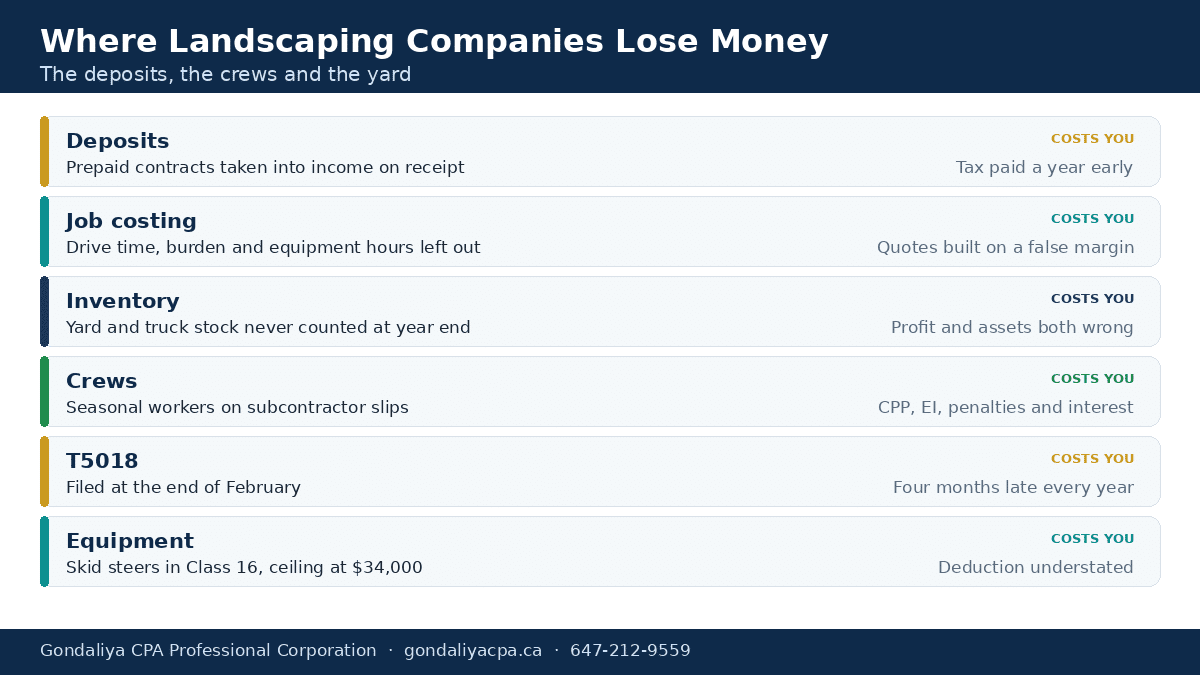
Cash flow changes with the seasons because revenue depends on weather and contracts. Seasonal payroll deductions need exact calculations, and late remittances can cause penalties. If crews are called subcontractors but really act like employees, the CRA may reassess and add charges.
Hiring a landscaping tax accountant who understands industry rules helps avoid mistakes. For example, construction jobs require T5018 slips. This expert advice keeps corporate filings correct and supports smart tax planning for landscaping firms across Ontario and Canada.
The T5018 return is not due at the end of February. Please file within six months of the end of your chosen reporting period. February is the T4 deadline and the two are conflated constantly.
Managing off-season cash flow fluctuations efficiently
Seasonal cash flow means you must plan instalment payments carefully and follow deferred revenue rules. Landscaping companies often get paid upfront for contracts, like maintenance work. These payments count as deferred revenue until the job is done.
You should forecast cash shortages during slow months. Buying equipment after busy seasons helps keep cash on hand. Instalments should match expected taxable income, not just cash received. Otherwise, you risk paying too much or penalties.
Keep detailed records of deferred revenue to follow CRA’s accrual rules. Check payment timing against actual work so you don’t report income too early.
A snow contract signed on 1 November for $12,000 covering November through March, paid in full up front, on a 31 December year end. Reported on receipt the whole $12,000 lands in year one. Recognised as delivered, $4,800 falls in year one and $7,200 in year two. At a combined small business rate near 11.2% the early recognition costs roughly $806 of tax a year sooner. Figures changed for privacy.
Optimizing discount strategies without harming profitability
Tax planning for landscaping corporations means using deductible expenses wisely while keeping profits healthy. Offering discounts can help get early payments or bigger orders but watch they don’t cut too deep.
Here are common deductible costs:
- Fuel and repairs for vehicles used in business
- Safety gear required by law
- Licenses and permits necessary for work
- Insurance premiums tied directly to operations
Keep good receipts that clearly link these expenses to your business. Discounts lower your reported revenue, so make sure your job costing shows positive gross profits after discounts. A CPA familiar with landscaping taxes can help balance pricing with tax rules.
| Expense Type | Deductible? | Conditions/Limitations | Documentation Needed |
|---|---|---|---|
| Fuel & Repairs | Yes | Must relate directly to business use | Receipts/logbooks |
| Safety Equipment | Yes | PPE required by law | Purchase invoices |
| Licenses & Permits | Yes | Only if mandatory | Licensing documents |
| Discounts Offered | Indirect | Reduce taxable revenue | Contract terms |
Accurate job costing and inventory tracking for materials and equipment
Job costing means tracking all costs tied to each project: crew hours, equipment use, materials, even disposal fees. This helps see which jobs make money.
For inventory, keep tabs on plants, salt for snow removal, mulch stocks — all at cost minus spoilage write-downs at year-end. Removing dead stock avoids overstating assets which can mess with profit calculations.
Don’t forget to include drive time when figuring labor costs. This makes bids more accurate and shows hidden overhead expenses clearly.
Truck stock across a service fleet is a real inventory balance and almost never counted. On a six-truck operation it is often the largest single year-end adjustment we make. Figures changed for privacy.
Streamlining payroll for seasonal workers and subcontractors
Handling seasonal payroll means following source deduction laws—CPP, EI (if needed), plus taxes—and sending payments on time. Issue records of employment quickly after layoffs since seasonal staff come and go a lot.
Deciding if workers are employees or subcontractors depends on control factors: who supplies tools? Who takes profit or loss? How tied are they to your core business? CRA uses strict tests here. Getting this wrong risks reassessments and penalties, especially if T5018 slips apply when contractors do construction tasks.
Using payroll software helps handle peak hiring times smoothly and keeps everything compliant.
Consulting and Advisory Services to Support Business Growth
Gondaliya CPA provides succession planning focused on making ownership changes smooth for incorporated landscapers. Risk reviews spot problems like missing licenses or poor record keeping flagged by regulators.
They also perform operational performance reviews using financial statements plus key numbers that help owners decide about growth or new investments.
These services give owners solid info so they can focus on running their businesses instead of worrying about audits triggered by cash deals without slips or GST/HST mismatches.
Strategic business planning and financial forecasting
Lenders want full financial statements showing clear snapshots with balance sheets, income statements, plus notes explaining work-in-progress balances near year-end. Compilation reports following CSRS 4200 give trust needed for loans or bonding in landscaping markets across Toronto/Ontario.
Deliverables often include monthly bookkeeping broken down by job costing plus deferred revenue reports. These help forecast cash flows through busy and quiet seasons so companies plan finances ahead.
Profit enhancement and cost control strategies
Deciding whether to buy, lease, or rent equipment depends on how much it gets used during the season. Capital cost allowance (CCA) rules apply with the half-year rule limiting depreciation amounts each year.
Recent changes allow quicker write-offs of smaller purchases which helps operators keep working capital tight. Buying may save money over time; leasing gives flexibility when usage is uneven.
Also watch fuel use carefully—track personal vs business miles to avoid GST/HST credit issues under Excise Tax Act rules.
Summary: Lease if you need flexibility; buy if you have steady demand to get max CCA benefits without hurting cash flow.
Please check whether investment income has crossed $50,000. The small business limit is reduced by $5 for every $1 above that and is eliminated at $150,000, so the grind starts well before the figure most owners watch for.
Review of operational processes for improved efficiency
A bookkeeping setup made for seasonal workflows works best when labour costs separate from materials in the chart of accounts. This makes month-end closing easier even during slow months.
Fixing missed filings means starting with oldest returns first to reduce late fees while asking for relief where there’s good reason.
Regularly matching bank deposits to prepaid contract invoices stops premature income recording errors ensuring deferred revenue follows Canadian accounting standards properly.
Succession and risk management planning
CRA tends to review landscaping businesses over things like:
- Cash jobs paid off-the-books risking reassessments
- Unsupported fuel claims raising audit questions
- Not deferring prepaid contract revenues causing income inflation
These issues cause trouble frequently.
Best practices include:
- Capturing receipts daily
- Monthly job-cost checks
- Tracking subcontractor slips closely
- Issuing layoff records per Employment Standards Act especially for part-time student hires common in Ontario landscapes.
This approach keeps your books cleaner year-round avoiding CRA headaches.
For help handling complicated accounting issues in landscaping call Gondaliya CPA at 647-212-9559 or email info@gondaliyacpa.ca for a free consult today.
Cash jobs without slips, unsupported fuel claims and prepaid revenue taken in too early are the three that draw a review. All three are documentation problems rather than tax problems. Figures changed for privacy.
Starting a Landscaping Business: Essential Accounting and Legal Steps
Starting a Landscaping Business: Essential Accounting and Legal Steps
Starting Out
Starting a landscaping business in Canada takes some serious thought, especially when it comes to money and legal stuff. Getting help from a landscaping company accountant Canada or a landscaping company CPA Canada early on makes things smoother. They’ll help you set up your books right and avoid big mistakes.
Business Plan Development and Financial Projections
Your business plan should be clear and show what money you expect to make. A landscaping tax accountant can help you guess income from things like seasonal jobs, installations, snow removal, and selling materials. You want to know when cash will come in so you don’t run out during slow times.
Your financial plan should include:
- How much money each service might bring in
- How busy or slow seasons affect your income
- Payroll costs with extra workers in busy months
- Plans for buying or leasing equipment
This helps if you need loans and sets goals that match your profit hopes.
Choosing Legal Structure and Registration Requirements
Picking the right legal setup changes your taxes, risks, and paperwork. Most landscapers choose to form a Canadian-controlled private corporation (CCPC). It gives some tax breaks under Canadian law. Smaller businesses might pick sole proprietorship or partnerships but miss out on these benefits.
You’ll need to:
- Incorporate federally or in Ontario
- Get a Business Number (BN) from CRA for GST/HST and payroll accounts
- Register for local permits if you do stuff like pesticide spraying or snow removal
A landscaping company CPA Canada can make sure you file everything correctly for your type of business.
Setting Up Tax Accounts and Business Banking Relationships
It’s best to set up your tax accounts early so paying taxes stays easy. Your landscaping tax accountant will guide you on signing up for:
- GST/HST account if you expect over $30,000 in sales yearly
- Payroll deductions account if you hire workers needing T4 or T4A forms
Open a separate business bank account to keep money clear between personal and work stuff. Many use accounting software that connects directly to their bank to track all transactions fast.
Understanding Insurance and Licensing Needs
Insurance doesn’t change your accounting but protects against risks like damaged equipment or worker injuries common in landscaping. Licensing rules differ by province. Keep good records of these rules but don’t treat this as permit advice here.
Registration for GST/HST is mandatory once worldwide taxable revenue exceeds $30,000 in a single calendar quarter or across four consecutive calendar quarters. In Ontario the rate is 13%.
Managing Finances and Accounting from Day One
Good money management starts on day one by using systems that keep track of all income and spending—a key part of landscaping accounting services.
Implementing Bookkeeping Systems to Track Income and Expenses
Bookkeeping is the base of good financial control in any landscaping business. Using cloud tools that connect with receipt capture programs lets you capture bills, receipts, payroll hours, plus job costs quickly.
You must sort costs right: direct job expenses (like onsite materials) versus overhead (like insurance). This helps report properly when it’s time to file taxes with help from your landscaping tax accountant.
Setting Pricing Strategies Aligned With Profitability Goals
Prices should cover all costs plus overhead while staying fair in your area’s market—say Toronto’s commercial grounds sector. Think about how fast crews work and how much materials cost when quoting jobs.
Check pricing regularly with real job cost reports so you don’t lose money unknowingly. CPAs who know landscape business numbers often spot problems before they get bad.
Establishing Payroll And Employee Management Protocols
Getting payroll right means following CRA rules on seasonal workers often used in lawn care crews. A good system tracks hours worked including overtime rules and makes T4 slips on time every year.
Your CPA will help sort out whether workers are employees or subcontractors so the right forms go out (T4 vs T5018). This avoids penalties linked to mixing things up at tax time.
Tools For Monitoring Business Performance And Cash Flow Regularly
Watching cash flow month-to-month helps avoid surprises during slow winters when many contracts pause. Software dashboards show unpaid invoices next due dates plus any prepaid seasonal jobs common among Ontario garden companies like those in Vaughan or Mississauga.
Keeping an eye on these numbers lets you plan equipment buys well before tax payments are due on yearly returns prepared by pros who know Canadian construction industry details.
For personalized help focused on incorporated landscapers around Toronto/Ontario who want affordable expertise, contact Gondaliya CPA at 647-212-9559 or info@gondaliyacpa.ca for a free talk about your landscaping accounting services needs.
Serving Landscaping Companies in Burlington, Oakville, Hamilton, and Beyond
Serving Landscaping Companies in Burlington, Oakville, Hamilton, and Beyond
Where We Serve
Landscaping companies in Canada need accounting help that fits their specific needs. A landscaping company accountant Canada knows the ins and outs of tax filings, bookkeeping, and rules for this business. These landscaping accounting services keep your finances right and help you save on taxes under Canadian law. If your landscaping business is incorporated and runs in places like Burlington, Oakville, or Hamilton, you want advice from a landscaping tax accountant. That advice helps you follow rules and boost your profits.
What we offer:
- Help with complex tax returns
- Accurate bookkeeping for your projects
- Advice on corporate compliance
Coverage of Key Cities and Regions in Southern Ontario and Across Canada
We serve incorporated landscaping companies Ontario-wide. Our work covers cities like Burlington, Oakville, Hamilton, and beyond. As a landscaping company CPA Canada firm, we understand local markets well. We handle issues like municipal licenses or payroll rules that differ by area.
We know the industry is wide. Some clients do lawn care. Others build hardscapes. We adapt our accounting services to fit these differences.
Key points we cover:
- Federal rules like CRA T2 corporate tax filing
- Regional employment standards for seasonal workers
- Payroll regulations by province
Local Knowledge Supporting Regulatory Compliance and Market Conditions
The Income Tax Act Section 125 and the CRA T2 Filing Guide have tricky rules for landscapers. We help you get them right. For example, when to count income from prepaid contracts or how to claim depreciation on equipment.
Local weather affects cash flow too. Southern Ontario has cold winters in Hamilton but milder ones near Oakville. We factor this in so your financial plans match real-life cycles.
A snow division in Ottawa carries a materially different deferred revenue position at 31 December than one in Windsor, and the instalment should reflect that rather than repeating last year. Figures changed for privacy.
Meet the Gondaliya CPA Landscaping Accounting Team
Gondaliya CPA is a Registered Ontario CPA firm focused on helping incorporated small businesses in horticulture and landscaping across Canada.
Profiles of Accounting Professionals with Landscaping Industry Expertise
Sharad Gondaliya leads our team. He’s a CPA licensed both in Canada and the USA. He has over ten years advising businesses like yours—especially landscape contractors close to construction fields.
Vandana Goel works with us too. She’s an expert in bookkeeping for landscapers using cloud accounting software. She makes sure job costing stays spot-on for your project billing.
Our team brings:
- Deep sector experience
- Cross-border accounting knowledge
- Practical tools for job costing accuracy
Credentials and Certifications Relevant to Horticultural and Landscaping Accounting
Our team holds strong credentials: full membership with CPA Ontario plus US CPA licenses valid in Washington State and Montana. This mix means we give advice based solidly on Canadian laws like the Income Tax Act and local labour rules affecting seasonal crews.
We also handle NUANS registration to support incorporation for new businesses needing proper legal setup before signing contracts or keeping CRA-required records.
Commitment to Personalized Client Service and Ongoing Support
We have over 1450 five-star Google reviews showing clients trust us. We respond quickly — even evenings or weekends during busy seasons or audits involving tough issues like subcontractor status or deferred revenue.
Our pricing is simple: flat fees covering bookkeeping setup, cleanup, T2 tax filing, GST/HST returns, plus payroll management built around seasonal labor patterns typical among snow removal or garden design firms.
If you want personal help tailored exactly to your landscaping company’s needs—from Burlington through Ottawa or beyond—call us at 647-212-9559 or email info@gondaliyacpa.ca for a free no-obligation chat.
Resources to Support Landscaping Accounting Success
Resources to Support Landscaping Accounting Success
The Resources
Running a landscaping business means dealing with money matters that can get tricky. You need landscaping accounting services that know the ins and outs of your trade. A landscaping company accountant Canada can help you sort through tax rules, bookkeeping, and GST/HST stuff that can confuse many.
If taxes make you scratch your head, a landscaping tax accountant knows how to find deductions and keep things legal with the CRA. Working with a landscaping company CPA Canada makes sure your books are right on time and help spot chances to grow your business.
Downloadable Profit Guides and Financial Planning Checklists
You can get profit guides made just for landscapers. They show where money comes in and goes out in your business. These guides break down expenses like:
- Labour costs
- Materials inventory
- Equipment upkeep
- Paying subcontractors
Financial checklists also help you get ready for year-end filings. They cover tricky areas like prepaid contracts or claiming capital cost allowances on machines. These lists stop common mistakes like wrong crew classification or missing T5018 forms.
Using these tools helps you keep an eye on your finances all year, without always needing an accountant’s help.
Access to Learning Center Articles on Cash Flow Management and Tax Tips
Our learning center has articles made for landscaping companies dealing with cash flow ups and downs. This is handy if you do snow removal or lawn care because your income changes through the year.
Some topics include:
- Handling tax instalment payments the right way
- When to recognize income under Canadian accounting rules (ASPE)
- How to claim input tax credits on fuel purchases correctly
- Differences in GST/HST rules between residential and commercial clients
These easy-to-read guides explain tricky tax stuff so anyone can understand how it affects their profits. The articles get updated often with new rules about T5018 reporting or payroll timing in Ontario jobs.
Case Studies Demonstrating Accounting Improvements for Landscaping Clients
Real examples show how working with a landscaping company CPA Canada improves accounting for landscapers. One client went from doing their own bookkeeping to getting precise job costing, which helped price their hardscape work better. Another case cut down wasted materials at a nursery by tracking inventory better.
Clients also avoided late tax penalties by filing returns on time after switching to expert help. Fixing crew classification stopped costly source deduction problems too. These stories prove why specialized landscaping accounting services work better than general ones.
The contract list and a handful of subcontractor invoices settle a landscaping file quickly. They show the deferred revenue position and the T5018 exposure in the same hour. Figures changed for privacy.
Contact Gondaliya CPA for Tailored Landscaping Accounting Services
If you run an incorporated landscaping business in Toronto, Ontario, or anywhere else in Canada, Gondaliya CPA offers services that fit what you need. Our team knows everything from setting up bookkeeping to yearly corporate tax planning under Canadian law.
Talk directly to our experts who get both landscaping business challenges and the tax rules you face across Canada.
Clear Calls-to-Action for Consultations, Inquiries, and Service Engagement
Ready to improve how you handle money? Book a free consultation with our Registered firm that focuses on landscaping companies only. We help whether you’re behind on filings or want advice about GST/HST rules on materials.
You can call us at 647-212-9559 or email info@gondaliyacpa.ca anytime during business hours—even weekends sometimes! We promise quick replies within one business day per our policies.
Multiple Contact Options Including Phone, Online Form With Inquiry Categories, And Newsletter Signup
We offer different ways to get in touch:
- Call us directly for fast answers
- Fill out an online form that sorts your questions fast
- Sign up for newsletters with updates on tax laws affecting landscapers everywhere in Ontario and Canada
This mix helps you learn while getting personal service made just for small landscaping businesses—from Etobicoke lawn care to Ottawa garden design or Windsor snow removal crews.
Invitation To Discuss Customized Solutions To Enhance Financial Management And Business Growth
Every landscaping business is different and needs solutions that fit just right—not off-the-shelf stuff. At Gondaliya CPA, we talk about how job costing systems can plug into the cloud accounting software we set up.
This gives clearer views of project profits even when work slows down seasonally—common in grounds care jobs.
Our goal is simple: help clients avoid audit troubles linked to employee vs contractor confusion, use capital assets properly under CCA rules, and manage deferred revenues the way CRA wants.
All this adds up to stronger finances supporting growth locally in Toronto/Ontario plus other parts of Canada where we serve clients.
Landscaping is a taxable supply. Residential lawn care is not exempt from GST/HST, and a registrant must charge HST on residential and commercial work alike. Please do not rely on guidance that says otherwise.
Frequently Asked Questions (FAQs) About Landscaping Company Accounting in Canada
Frequently Asked Questions (FAQs) About Landscaping Company Accounting in Canada
FAQ
What is the T2 Corporate Tax Return filing deadline for landscaping companies?+
The T2 filing deadline is six months after your fiscal year-end. Filing late may cause penalties and interest.
How often should a landscaping company file GST/HST returns?+
GST/HST return frequency depends on your annual taxable sales. Most small businesses file quarterly or annually.
When must payroll source deduction remittance be submitted?+
Payroll deductions must be remitted monthly or quarterly by the 15th of the following month to avoid penalties.
What is the T5018 contract payment reporting deadline?+
T5018 slips for subcontractor payments are due six months after the end of your chosen reporting period.
What is the Capital Cost Allowance half-year rule?+
The half-year rule limits CCA claims on newly acquired assets in their first year, allowing only half the normal deduction.
How long should landscaping companies keep their records?+
CRA requires a minimum retention period of six years from the end of the last tax year a return applies to.
What penalties apply if a landscaping company files taxes late?+
Late filing can trigger penalties up to 5% of unpaid tax plus 1% per month late, along with interest charges.
What is the Small Business Deduction limit for incorporated landscapers?+
The federal Small Business Deduction limit is $500,000 in active business income for eligible Canadian-controlled private corporations.
Is residential lawn care exempt from GST/HST?+
No. Landscaping and lawn care are taxable supplies whether the customer is residential or commercial. A registrant must charge HST on both, and in Ontario the rate is 13%.
What class does a skid steer belong in?+
Class 38 at 30%. Class 16, which appears in a lot of older contractor guidance, covers taxis, rental vehicles, coin-operated machines and certain freight trucks.
What is the passenger vehicle ceiling for 2026?+
$39,000 before tax under Class 10.1, up from $38,000 in 2025. The Class 54 zero-emission ceiling is $61,000, the lease cap is $1,100 per month and deductible interest is $350 per month.
Did the capital cost allowance rules change in 2026?+
Yes. Bill C-15 received Royal Assent on 26 March 2026, reinstating the accelerated investment incentive with an enhanced first-year deduction for most property acquired after 2024 and available for use before 2030.
When is the corporate tax balance due?+
Three months after year end for a CCPC claiming the small business deduction, and two months after year end otherwise. This is earlier than the filing deadline.
How does passive income affect my small business deduction?+
The limit is reduced by $5 for every $1 of adjusted aggregate investment income above $50,000, eliminating it entirely at $150,000.
What is the combined small business tax rate in Ontario?+
Ontario reduced its small business rate to 2.2% effective 1 July 2026, giving a blended provincial rate near 2.7% for a calendar-year corporation and a combined rate near 11.7% with the federal 9%.
When does a crew truck going home create a taxable benefit?+
When the vehicle is available for personal use. The standby charge turns on availability rather than distance, plus an operating benefit for costs the business paid.
Key Points at a Glance: Essential Tax and Accounting Deadlines for Landscaping Companies
Key Points at a Glance: Essential Tax and Accounting Deadlines for Landscaping Companies
Quick Reference
- T2 Corporate Tax Return: File within 6 months after fiscal year-end.
- GST/HST Returns: Quarterly or annually, based on sales volume.
- Payroll Remittance: Due monthly/quarterly by the 15th next month.
- T5018 Reporting: Submit slips six months after your reporting period ends.
- Records Retention: Keep books for at least 6 years.
- Capital Cost Allowance (CCA): Apply half-year rule in year one of asset acquisition.
- Late Filing Penalty: Minimum 5% plus monthly interest on unpaid amounts.
Carry prepaid maintenance and snow contract money as a liability until the work is delivered. Calculate instalments on taxable income rather than cash. Attach every cost layer to the job before setting a price. Count yard and truck stock at year end. File T5018 six months after your period ends. Charge HST on residential and commercial work alike. Put skid steers in Class 38 and use the $39,000 ceiling. Please keep six years of records.
Quick Comparison Table: DIY vs CPA vs Non-CPA Providers for Landscaping Accounting
Quick Comparison Table: DIY vs CPA vs Non-CPA Providers for Landscaping Accounting
Common Questions
| Service Aspect | DIY Approach | Non-CPA Provider | Gondaliya CPA (CPA Firm) |
|---|---|---|---|
| Industry-Specific Knowledge | Limited | Moderate | Expert with landscaping focus |
| Compliance Accuracy | Risk of errors | Some expertise | High accuracy with CRA rules |
| Tax Planning | Basic deductions only | Basic strategies | Advanced planning including CCA & deferred revenue |
| Audit Support | None | Limited | Full support including CRA reviews |
| Software Integration | Manual data entry | Varies | Cloud accounting integration |
| Cost | Low | Medium | Transparent flat fees |
How Do You Cost a Landscaping Job Properly?
Accurately costing a job means tracking labor hours, materials used, subcontractor fees, and equipment wear. Add indirect costs like insurance and overhead. Use detailed job costing reports to price competitively while ensuring profit margins.
Buy, Lease or Rent Landscaping Equipment: Which Route Fits?
Buying suits steady use and maximizes tax benefits via CCA claims. Leasing offers flexibility if equipment use varies seasonally. Renting fits short-term or special projects but usually costs more over time. Analyze cash flow impact before deciding.
What Financial Statements Will a Lender or Bonding Company Expect?
Lenders want clear balance sheets, income statements, and cash flow reports showing work-in-progress balances near fiscal year-end. Compilation reports prepared by CPAs add credibility to your financials when seeking loans or bonds.
What Are the Filing Deadlines a Landscaping Corporation Must Meet?
File corporate tax returns (T2) within six months post fiscal year-end. Submit GST/HST returns based on assigned frequency—monthly, quarterly, or annually. Remit payroll source deductions regularly by CRA deadlines to avoid penalties.
What Penalties and Interest Apply If You File Late?
Late tax filings attract immediate penalties of at least 5% of unpaid tax plus 1% monthly interest up to 12 months. Payroll remittance delays lead to separate fines and interest charges from CRA.
What Tax Planning Options Suit a Landscaping Corporation?
Tax planning includes optimizing capital cost allowance claims on equipment, deferring income recognition appropriately, maximizing deductible expenses like fuel and repairs, and managing prepaid contracts carefully to avoid early revenue recognition issues.
What Triggers a CRA Review of a Landscaping Business?
Common triggers include inconsistent payroll remittances, missing T5018 reporting for subcontractors, incorrect employee vs contractor classification, late tax filings, high cash transactions without receipts, and unsupported input tax credits claims.
How Do You Catch Up on Missed Filings and Messy Books?
Start by organizing past financial records chronologically. Address oldest returns first to reduce penalties. Work with a CPA firm like Gondaliya CPA for clean-up bookkeeping and proper T2 filings while requesting penalty relief where justified.
What Are the Best Practices to Run the Year Efficiently?
Use cloud accounting software linked with receipt capture tools monthly. Perform regular bank reconciliations and GST/HST reviews. Track deferred revenue accurately and maintain detailed job costing throughout all seasons for timely decision-making.
Landscaping Accounting: DIY vs CPA vs Non-CPA Provider – Which Route Fits?
DIY suits very small operations but risks compliance errors. Non-CPA firms offer basic bookkeeping but may lack industry knowledge needed for complex issues. CPAs (Chartered Professional Accountants) provide expert guidance tailored to landscaping industry rules ensuring accuracy and savings.
How Do We Handle Landscaping Company Files at Gondaliya CPA?
We organize documents digitally using secure cloud platforms integrated with accounting software. Monthly bookkeeping reviews ensure up-to-date records. We prepare accurate financial statements and corporate tax returns aligned with CRA requirements.
What Deliverables Do You Get from Gondaliya CPA?
Clients receive monthly financial reports including job costing summaries, GST/HST filings, payroll remittance reports, corporate tax return preparation with strategic advice, and ongoing access to experts for audit support or queries throughout the year.
How Much Does Accounting and Tax Cost for a Landscaping Company in Canada?
Costs vary by business size but expect transparent flat fees covering bookkeeping setup, monthly records maintenance, T2 filings, GST/HST returns, payroll management geared toward seasonal work patterns typical in landscaping industries across Canada.
What Are the Top Mistakes and How Do You Prevent Them?
Top mistakes include misclassifying employees as subcontractors, not tracking deferred revenue properly, late payroll remittances causing penalties, poor job costing leading to underpricing jobs, and missing capital cost allowance claims. Prevention requires specialized CPA support focused on landscaping specifics.
What Should You Prepare Before an Engagement Starts?
Have all prior financial records organized: bank statements, receipts linked to jobs/expenses, payroll details including employee classifications; records of subcontractor payments; any previous GST/HST filings; contracts involving prepaid revenues; equipment purchase invoices for CCA purposes.
How Do Accounting Needs Differ Across 10 Landscaping Segments We Serve?
Different segments—lawn care, hardscaping installation, snow removal—vary in cash flow cycles and expense types requiring tailored accounting setups like seasonal payroll handling or specialized inventory tracking adapted per sector nuances that Gondaliya CPA knows well.
A Realistic Numeric Walkthrough
Consider a medium-sized landscaping firm earning $800K yearly with seasonal spikes requiring extra staff from April through October. Monthly bookkeeping tracks fluctuating labor costs plus material inventory valued at $50K year-end supporting accurate deferred revenue reporting minimizing tax exposure risks effectively managed by expert CPAs.
How to Choose the Right CPA Firm in Toronto/Ontario for a Landscaping Company?
Look for firms with proven industry expertise managing seasonal businesses subject to complex tax laws like capital cost allowance rules specific to landscaping equipment usage patterns plus solid client testimonials confirming personalized service availability during peak seasons or audits.
Why Trust Gondaliya CPA?
Gondaliya CPA holds full registration under CPA Ontario plus US credentials offering cross-border insights helpful if you do work near border regions or import/export equipment. Our team’s decade-long focus on horticultural industries ensures clients get precise advice supporting growth while staying compliant nationally.
The operation changes where the planning concentrates. It does not change the method, which is get the revenue timing right, settle who is an employee, then classify the fleet properly. Figures changed for privacy.
Who This Is For
- For: Incorporated landscaping companies across Canada, including lawn maintenance contractors, design-build and hardscaping firms, tree care and arborist operations, irrigation installers, nursery and garden retailers, commercial grounds contractors and snow removal divisions.
- Also for: Owners setting a corporation up for the first time, owners several years behind on filings, and owners preparing statements for a lender or bonding company.
- Not for: Unincorporated sole proprietors and partnerships, whose filing obligations run through a personal return rather than a T2.
- Not for: Municipal licensing, pesticide applicator certification, WSIB classification appeals and horticultural trade qualifications, which sit with the relevant authority rather than accounting.
- Not for: Construction lien interpretation and contract drafting, which are legal questions for counsel.
People Also Ask
People Also Ask
Guidance
How do I file my GST/HST if I have residential landscaping clients?+
Landscaping services are taxable supplies for residential and commercial customers alike—consult your accountant for specifics.
Can I claim fuel expenses used partially for personal use?+
Only business-use portion supported by mileage logs is deductible per CRA guidelines; personal use portions are excluded from claims.
When should I issue T5018 slips?+
For payments over $500 made to subcontractors performing construction-type work during the reporting period, filed within six months of the period end.
Glossary of Key Terms
- CCA (Capital Cost Allowance): Tax depreciation method applied on capital assets over time.
- Deferred Revenue: Money received before services are performed; recognized as income later.
- T2 Return: Corporate income tax return filed annually by incorporated businesses.
- T5018 Slip: Reporting form issued for payments made to subcontractors in construction sectors.
- Payroll Source Deductions: Taxes withheld from employees’ paychecks remitted regularly to CRA.
- Accrued Revenue: Work performed but not yet billed at the year end.
- Job Costing: Attaching every cost layer to the job that incurred it.
- Employer Burden: CPP, EI, WSIB and vacation pay loaded on top of wages.
- Record of Employment: The form issued on each interruption of earnings, including seasonal layoff.
- UCC (Undepreciated Capital Cost): The remaining tax value of a capital cost allowance class.
- Recapture: Income added back when an asset is sold above its undepreciated capital cost.
- Class 8: The 20 percent capital cost allowance class covering mowers, aerators and shop equipment.
- Class 38: The 30 percent class covering skid steers, excavators and heavy excavation equipment.
- Class 10.1: A separate class opened for each passenger vehicle above the prescribed cost ceiling.
- Accelerated Investment Incentive: The enhanced first-year deduction reinstated by Bill C-15 in 2026.
- Standby Charge: The taxable benefit arising when a company vehicle is available for personal use.
- Input Tax Credit: The GST/HST recovered on business purchases supported by a supplier invoice.
Next Steps
Contact Gondaliya CPA today at 647-212-9559 or info@gondaliyacpa.ca for tailored landscaping accounting help across Canada. Book your free consultation now to improve compliance and boost profitability using expert services crafted just for your business needs.
Related Gondaliya CPA Resources
- Accounting and tax services for landscaping companies
- Accounting and tax services for lawn care businesses
- Accounting and tax services for snow removal businesses
- T5018 filing requirements explained
- GST/HST registration for a new corporation
- Input tax credits in Canada
- Corporate tax preparation and filing
- What a CRA audit involves
- The Voluntary Disclosures Program
- Contact Gondaliya CPA
Landscaping Readiness Check
This quick self-check indicates where your operation most likely has room. Please answer the six questions below.
Landscaping Readiness Check
Six quick questions on your company. No fee shown.
Points to raise with us:
This is a general prompt, not tax or legal advice or a quote. Your position depends on your full facts. For a real review, please book a free consultation.
Want a checklist to work from? You can download our free landscaping company tax checklist before your consultation.
Start with the contract list
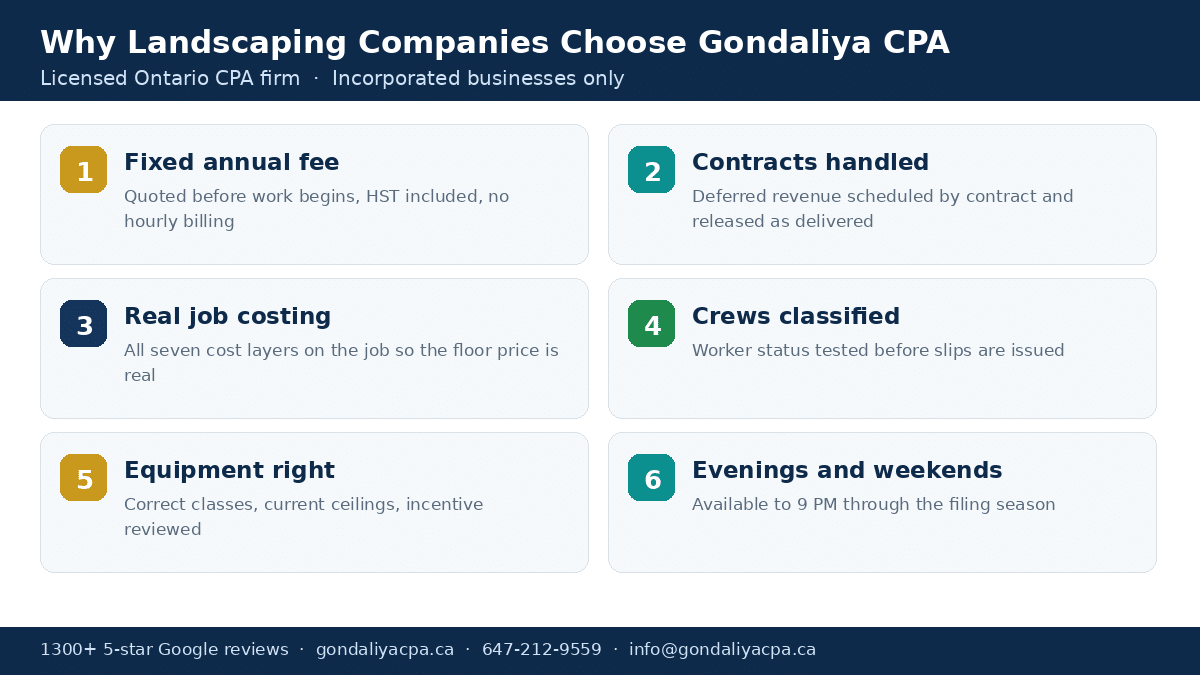
Gondaliya CPA builds the deferred revenue schedule by contract, counts yard and truck inventory, prepares T5018 on the correct period and deadline, tests worker classification against the CRA factors, applies the current equipment and vehicle classes and reviews the reinstated investment incentive, on a flat annual fee including HST with a one-business-day response. Please book a free consultation.
Published: · Last updated:
Editorial policy: We research against CRA and CPA Ontario sources, fact-check the figures, and Sharad Gondaliya, CPA, reviews the content, which we update as the rules change.
Disclaimer: This article is educational information only and is not tax, legal, or financial advice. Figures marked illustrative are examples rather than quotes or guarantees. It reflects CRA rules current to 2026, including the $30,000 GST/HST threshold, the Class 8 rate, the half-year rule and its 2026 suspension, and the six-year retention requirement. Rates, limits and expensing rules change and outcomes depend on your specific facts. Please consult a CPA Ontario member before acting.

Sharad Gondaliya is a CPA Canada & CPA USA with 15 Years+ experience of Accounting, Tax, Payroll of Corporate Small Businesses as Tax Accountant. He is a CPA Ontario member (61040184) and holds US CPA licences in Washington and Montana and is well known among corporate small businesses for tax planning, efficient tax solutions, and affordable CPA services. Sharad is the Principal (Director) of Gondaliya CPA – Affordable CPA Firm in Canada. Licenses: CPA Ontario: 61040184 | CPA USA (MT): PAC-CPAP-LIC-033176 | CPA USA (WA): 57629 | CPA Firm License: 61330051 View Full Author Bio