



Private Investigator Tax Rules in Canada: Vehicle Use, Surveillance Equipment & Client Expenses
Private Investigator Taxes Canada: Understanding Tax Rules, Business Expenses, and Accounting for PI Professionals with Gondaliya CPA
Private investigator taxes Canada require careful attention to tax rules, business expenses, and proper accounting to ensure compliance and savings. Gondaliya CPA offers guidance on managing private investigator business expenses such as vehicle use, surveillance equipment, and client expenses, as well as bookkeeping and tax filing tailored to private investigation professionals.
Quick Summary
Three things decide a private investigator’s return, and all three come down to what the log says. Vehicle costs are capped three separate ways — a prescribed ceiling on the capital cost of a passenger vehicle, a monthly lease limit under Regulation 7305(1), and an annual interest cap under 67(2)(b) — and the deductible share is whatever the mileage log supports, with each trip carrying a date, a distance, a purpose and a file reference. Surveillance equipment is capital property depreciated under Schedule II, claimable only from the date it is available for use and only to the extent of business use, with recapture on disposal. And client disbursements recharged at exact cost are not income and not an expense — but without a written reimbursement policy they become ordinary revenue. Records go back six years.
Reading time: 27 minutes.
Table of Contents
- Overview of Private Investigator Taxation
- Business Expenses and Tax Deductions
- Bookkeeping Best Practices
- Filing Taxes and Regulatory Compliance
- Professional Development Opportunities
- How Gondaliya CPA Supports Investigators
- Frequently Asked Questions
- Key Tax and Accounting Insights
- Businesses We Serve & Industry Spotlights
- Professional Guidance and Quick Reference
The Numbers That Matter
This article covers Canada, with Ontario and Toronto context, and reflects rules current to 14 October 2026. It is written for Canadian private investigators and investigation firms, whether self-employed and reporting on a T2125 or incorporated and filing a T2, and it focuses on vehicle use, surveillance equipment, client disbursements and the records that support each. It is not advice on provincial private investigator licensing, surveillance law or privacy legislation, each of which is regulated separately. Gondaliya CPA performs compilation engagements under CSRS 4200, which provide no assurance; audit and review engagements are referred out. This is educational information only and not tax or legal advice.
Overview of Private Investigator Taxation in Canada
Overview of Private Investigator Taxation
The Basics
Private investigators in Canada deal with specific tax rules. These rules can get a bit tricky if you don’t know them well. Knowing how private investigator taxes work is key to staying out of trouble and managing money right. This overview covers the main points, like who watches over the taxes, what rules apply, types of private investigators, and why good record keeping matters.
Understanding Tax Obligations for Private Investigators in Canada
Private investigators must follow tax rules set by the Canada Revenue Agency (CRA). They may work for themselves or run a company. Both have to file taxes properly and on time. If a private investigator runs a corporation, they use form T2 to file their corporate taxes. Missing deadlines or messing up filings can lead to fines or audits by the CRA.
Here’s a quick look at tax duties:
- File accurate income returns.
- Meet deadlines for submitting forms.
- Watch out for penalties from CRA.
Key Tax Rules Affecting Private Investigation Professionals
Some tax rules affect how private investigators claim expenses and deductions:
- Vehicle Use Deduction Limits: Many private investigators drive for work. Still, there’s a cap on how much they can deduct based on what type of vehicle they use.
- Prescribed Ceiling on Passenger Vehicles: The Income Tax Act sets a maximum cost for passenger vehicles. You can’t claim more than that, even if your actual expenses are higher.
Knowing these limits helps private investigators avoid mistakes and get all allowed deductions.
Definition and Classification: Self-Employed vs Corporate Private Investigators
Private investigators might work solo or run a corporation. This choice changes how they pay taxes:
- Self-Employed: You report your earnings on your personal tax return.
- Corporate Entities: If you incorporate, you file separate corporate returns with form T2. This may bring different tax rates but also more rules to follow.
In Ontario, corporate tax filing has specific deadlines that show how provinces handle things differently. Deciding between self-employed or incorporated often depends on income size and business setup. Some do their own bookkeeping, while others hire CPAs for help.
Importance of Accurate Tax Reporting and Compliance
Keeping good records matters big time for private investigators. The CRA wants you to keep your papers for six years after you file your last return. This includes income statements, receipts, and expense details.
Here’s why this matters:
- Good records back up what you claim.
- They lower the chance of getting audited.
- CRA checks might happen if mileage logs or expenses don’t add up.
Tracking everything carefully makes dealing with CRA easier and safer later on.
By understanding these basic tax points, private investigators can handle their money duties better and avoid surprises from the tax office.
An investigator claimed almost his entire vehicle cost on the basis that he drove nowhere except to surveillance sites.
That was probably true. There was no log, so none of it was provable, and the claim came down to the share he could actually support from fuel receipts and a calendar. The driving had all been business. The deduction was not, because nothing recorded it at the time. Figures changed for privacy.
Business Expenses and Tax Deductions for Private Investigators
Business Expenses and Tax Deductions
Deductions
Private investigators in Canada need to keep a close eye on their business expenses. Doing so helps them follow private investigator tax rules Canada properly. When expenses are tracked right, taxable income goes down. It also keeps the CRA happy. This section covers main expense types, record-keeping needs, and how these affect private investigator taxes Canada.
Recognizing Deductible Business Expenses for Private Investigators
Deductible business expenses are costs that help you earn money from investigation work. Some usual examples:
- Vehicle costs
- Surveillance gear
- Client-related spending
- Office supplies
- Licences and insurance
- Subcontractor fees
The Income Tax Act says expenses must be reasonable. You also need good records that link costs directly to specific jobs or business work. Personal stuff like living costs never counts as deductible.
If you use things like computers or cameras for both work and personal use, you can only deduct the part used for business. Bookkeeping has to be clear. Without proof linking spending to specific files, the CRA might reject your claims during an audit.
Classify expenses right so you follow private investigator tax rules Canada. Keep logs with dates, payment amounts, reasons for each cost, and file references. That helps back up deductions if CRA asks later.
Vehicle Expenses and Mileage Claims for Investigation Work
Vehicle costs make up a big chunk of private investigator business expenses Canada but come with strict CRA rules.
Here’s what you should know:
- The capital cost allowance (CCA) on passenger vehicles has a set ceiling each year by the CRA. This means you can’t claim depreciation above that ceiling even if your car cost more.
- Monthly lease payments face limits too under Regulation 7305(1). You can’t deduct more than allowed each month.
- Interest on vehicle loans has an annual cap under subsection 67(2)(b).
- You might get a business mileage rate to cover costs, but actual deduction depends on accurate logs—not just flat rates.
Your mileage log must include:
- Date of travel
- Distance driven (business vs personal)
- Trip purpose with client file numbers
This detailed log is sometimes called the LOCK — Log Of Client Knowledge. It locks down which trips count as business.
Driving from home counts as business travel only if your work locations change daily. If it’s a regular commute, it’s usually not deductible. Your log should clearly show times and places to prove this.
You can only claim vehicle expenses proportional to the logged business use when filing taxes (T2 or self-employed). Without proper logs tied to client files, you risk losing deductions and facing penalties.
| Cost Type | Treatment | Records Needed |
|---|---|---|
| Capital Cost Allowance | Capped by CRA ceiling | Purchase invoice + vehicle class |
| Lease Payments | Monthly limit applies | Lease contract + payment slips |
| Interest Expense | Annual cap | Loan documents |
| Fuel & Maintenance | Based on business km proportion | Detailed mileage log |
| Parking & Tolls | Deductible if linked to files | Receipts + log notes |
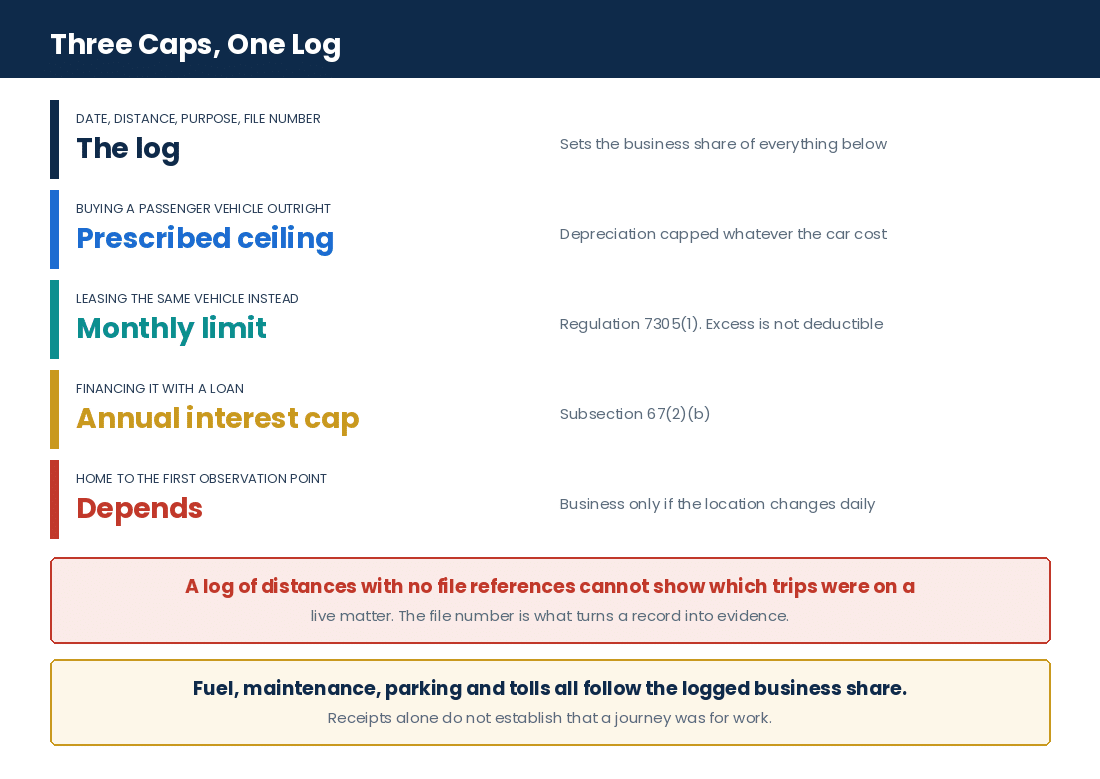
A firm kept a log faithfully: date, odometer start, odometer end, every trip for two years.
No file references. When the review came, there was no way to show which of those trips were surveillance on a live matter and which were the drive to the office, so the whole log did less work than it should have. The file number is the column that turns a distance record into evidence. Figures changed for privacy.
Surveillance Equipment: Tax Treatment and Deductibility
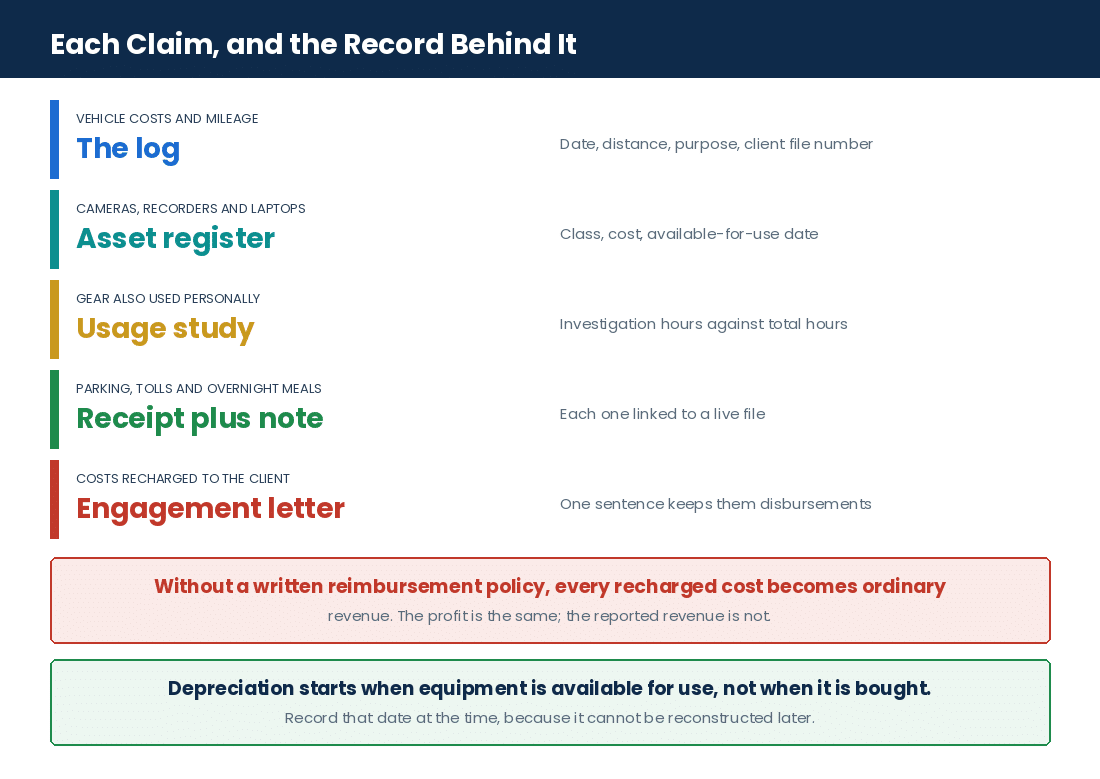
Surveillance gear like cameras or audio recorders usually count as capital assets. You depreciate them under certain classes listed in Schedule II of Regulation 1100. Computers used mostly for investigations fall here too but only their work portion counts if they serve some personal use.
You start depreciation when gear is ready for use in your work—not just when you buy it. Selling this equipment may cause recapture adjustments that affect taxable income.
To figure out how much is business use versus personal, keep good usage logs or software reports showing hours spent strictly on investigations compared with total use.
When selling surveillance equipment that got depreciation claims before, special rules apply. You must report sale proceeds separately and handle possible recapture based on undepreciated costs.
Cameras are deductible only if they serve real investigative purposes supported by invoices showing purchase dates linked to active client files.
Client-Related Expenses and Reimbursement Policies
Sometimes you pay costs upfront for clients. These might be:
- Recharged disbursements
- Regular fees absorbed into charges
If you pass exact costs back without markup, those recharges don’t count as income or deductible expenses—they just flow through your books unchanged.
If those costs are bundled inside fees with no clear reimbursement policy, then they become regular revenue. Your related expenses become normal deductible business costs.
Clear contracts spelling out what’s reimbursed versus what’s part of fees help during audits. They avoid mistakes that can mess up your taxable profit calculations.
Keep copies of these contracts plus matching invoices. This proves correct treatment of client-related spending and reduces audit risks.
An investigator charged clients a flat daily rate that quietly covered parking, tolls and meals, with nothing in the engagement letter about reimbursement.
Every dollar of it was revenue, and the costs behind it were ordinary deductible expenses — which is a different and worse answer than a pass-through. The profit was identical. The reported revenue was materially higher, and that is the figure CRA compares across years. Figures changed for privacy.
Other Common Business Costs Eligible for Tax Deductions
Here are some common extras that investigators can deduct:
- Meal expenses during overnight watches have a set limit per meal (now $23). Any excess isn’t deductible even with proper records using meal timing tied back via LOCK principles
- Parking fees while working in the field are deductible if you keep receipts plus notes linking charges to cases
- Toll charges get similar treatment—show proof with receipts and explain why they were needed for investigation work
These overheads show up regularly in private investigator accounting Canada but demand solid record keeping. Keep all receipts and documents at least six years after filing taxes per CRA rules.
For questions about motor vehicles or mixed-use assets, contact Gondaliya CPA’s Ontario team who know corporate tax filing for investigation businesses across Toronto and beyond.
Income Tax Act s18(1)(a) · CRA Guide T4002 – Self-employed Business Owner’s Guide · ITA Regs Schedule II Class definitions · CRA Passenger Vehicle Prescribed Ceiling · ITA Regs s7305(1) · CRA Motor Vehicle Expense Rates · ITA s248(1) definition “log” · ITA Interpretation Bulletin IT-529R “Automobile Benefits” · ITA Regs Schedule II Classes · Income Tax Act ss13(g), ss67 series regulations schedule II commentary · Income Tax Act ss18(a), ss67 series guidance notes re reimbursements/disbursements policy · CRA Audit Manual Section B3 – Documentation Requirements · IT Regulations Meal Limit Guidance · CRA Records Retention Policy
Contact Gondaliya CPA at info@gondaliyacpa.ca or call 647-212-9559 for help handling private investigator taxes Canada while keeping track of all allowable private investigator business expenses Canada correctly.
Best Practices for Private Investigator Bookkeeping in Canada
Bookkeeping Best Practices
Bookkeeping
Keeping good books is a must for private investigators in Canada. It helps manage taxes and business costs right. You need to keep track of every dollar coming in or going out. This way, you follow private investigator taxes Canada rules and avoid issues during audits.
Here are some tips:
- Use separate accounts just for your business money.
- Write down each expense with a clear file reference tied to the case.
- Check your bank statements regularly to catch mistakes early.
Label expenses based on CRA rules. That way, you can spot deductible private investigator business expenses Canada easily. These include vehicle costs, gear you buy, client disbursements, and payments to subcontractors. Keeping books up-to-date also helps with GST/HST filing.
Make sure you log your mileage carefully. Link trips to specific files because CRA expects that. They watch vehicle costs closely under their motor vehicle expense rules, CRA Income Tax Folio S4-F3-C1. Following the LOCK principle helps here: Log your trips, prove Ownership, Classify properly, and Keep records.
Doing this cuts risks when auditors come knocking.
Organizing Records to Support Tax Filings and Audits
Good record keeping backs up your tax claims under private investigator taxes Canada laws. The CRA wants proof like:
- Receipts and invoices
- Contracts showing how disbursements work
- Mileage logs with date, distance, purpose, and file reference
- Details about equipment bought or sold
- Agreements with subcontractors stating payments and roles
Keep these documents at least six years after the tax year ends, Income Tax Act s230. Your mileage logs must show which trips are business-related, not personal commuting. Each entry needs a file reference tying it back to the client or case.
Without clear links, expenses like parking or meals could get rejected as deductions since they don’t prove work use.
File references do more than track travel costs. They show which expenses belong to billable investigations versus general overhead or personal stuff. Solid paperwork lowers chances of disputes over what counts as deductible private investigator business expenses Canada during an audit.
Recommended Accounting Methods for Private Investigators
Private investigators have options: do bookkeeping yourself (DIY), hire a CPA, or use a non-CPA bookkeeper. Each choice has pros and cons.
DIY suits simple setups but risks errors on tricky tax parts like vehicle use or mixed personal/business assets. Non-CPAs handle routine tasks but may miss updates on CRA rules affecting deductions like gear or corporate filings.
At Gondaliya CPA, we offer flat-fee service that covers everything from intake interviews to vehicle classification based on current rules for 2026 thresholds. We check mileage logs carefully so each trip shows date/distance/purpose/file reference. We also calculate usage for assets like cameras partly used personally, CRA ITA ss18(1)(a), Reg 1100. Before filing, we run compilation reports to catch errors.
This method reduces audit chances while making sure you claim what’s fair under private investigator accounting Canada standards.
An investigator ran everything through one chequing account — client retainers, personal rent, fuel, a camera body, groceries.
Reconstructing which transactions were business took longer than preparing the return, and several equipment purchases could not be tied to a date of availability for use. A separate business account costs nothing to open and removes most of that work permanently. Figures changed for privacy.
Managing Cash Flow and Client Billing Efficiently
Knowing how to handle recharged costs versus income matters for taxes under Canadian law, ITA s67. If you bill clients exactly what you pay out-of-pocket without markups, that’s usually non-taxable reimbursement—not income—but you need written agreements spelling this out clearly.
Keep billing records separate:
- Pass-through charges (parking, tolls, meals) backed by receipts linked to files
- Normal fees invoiced per contract terms
Mixing these can lead to mistakes: overstated income or missed deductions if auditors dig into returns filed under private investigator self-employed taxes Canada rules.
Good cash flow means sending invoices fast tied to project steps. Then reconcile bank deposits often so money covers payroll and other costs, CRA Payroll Deductions Tables.
Clear reimbursement policies upfront cut disputes and improve cash predictability needed for bigger operations serving clients across provinces familiar with interprovincial GST/HST rules, Excise Tax Act ss165 & 169.
Technology Tools and Software Suitable for PI Accounting
Technology makes bookkeeping easier—especially when filing corporate taxes involving many cost centres common in investigation firms operating nationwide including Ontario.
Popular cloud tools like QuickBooks Online and Xero fit well here. They let you enter transactions in real time using categories CRA accepts—important for private investigators’ unique needs like mileage tracking linked to client files, CRA Motor Vehicle Expense Guide.
Payroll software such as Wagepoint automates government remittances so fewer mistakes happen when paying subcontractors who might be workers or contractors under ITA definitions, ITA s125.
Extras like Hubdoc help store digital copies of invoices and receipts sorted by date/client/matter. This keeps you ready for CRA’s six-year document retention rule without clutter piling up at home offices typical of small or new PI firms managed remotely.
Companies like Gondaliya CPA combine these tech tools with hands-on accounting help plus advice focused on investigation firm owners needing affordable expert guidance backed by strong local experience and trusted reviews.
Need help with private investigator taxes Canada questions or want smart private investigator accounting Canada advice? Email info@gondaliyacpa.ca or call 647-212-9559 for a free talk about your firm’s financial setup—no strings attached.
Private Investigator Tax Check
Five quick questions on where your records stand. No fee shown.
Points to raise with us:
This is a general prompt, not tax or legal advice or a quote. Your position depends on your full facts. For a real review, please book a free consultation.
Filing Taxes and Regulatory Compliance
Filing Taxes and Regulatory Compliance
Filing
Step-by-Step Guide to Filing Private Investigator Taxes in Canada
Filing private investigator taxes in Canada takes careful record-keeping. Private investigators must keep track of all business expenses, income, and follow the private investigator tax rules Canada set by the CRA. This means logging vehicle use, gear costs, client expenses, and payments to subcontractors. Using corporate tax filing and bookkeeping services can help make sure deductions are claimed right and rules are met.
First, gather all financial papers like invoices, receipts with file numbers, mileage logs for vehicles used during investigations, and expense reports for things like surveillance gear or meals related to work. Next, prepare income statements showing fees earned from cases across provinces if needed.
Finally, file returns based on your business type. Sole proprietors and corporations use different forms but both follow CRA rules about allowable deductions under laws like Income Tax Act s.18(1)(a). Good accounting software can make this easier by keeping records up to Canadian standards.
Provincial and Federal Tax Filing Requirements
Private investigation businesses must obey federal rules under Income Tax Act section 150 about corporate taxes, Income Tax Act s.150. If incorporated in Ontario or across Canada:
- You must file a T2 Corporate Tax Return.
- Returns are due six months after your fiscal year ends.
- Late filing can lead to penalties unless CRA grants relief.
If you run a sole proprietorship, report your income on your personal T1 return using Form T2125 (Statement of Business Activities). Both setups need to keep proof like logs that show how much you used assets for business, CRA Motor Vehicle Expenses.
Provinces may have extra rules, like Ontario’s HST. These affect what input credits you can claim during tax periods. These often match federal deadlines but depend on local thresholds.
Understanding GST/HST Obligations for Investigation Services
If you provide investigation services that are taxable, you must know GST/HST registration rules under Excise Tax Act s.169. If your yearly revenue from taxable supplies goes over $30,000 in four straight calendar quarters — this is called the GST/HST Small Supplier Threshold — then you must register.
After registering:
- Charge GST/HST on your invoices.
- Claim input tax credits on eligible business purchases.
- Keep clear records separating taxable and exempt sales.
Failing to register on time can cause interest charges and reassessments. That messes up cash flow for firms working with many clients across provinces.
Corporate Tax Considerations for Incorporated PI Firms
Incorporated PI firms have special deadlines. In Ontario for 2026 rules:
- File T2 returns no later than six months after fiscal year-end, CRA Corporate Deadlines 2026.
- Watch capital cost allowance claims—especially for passenger vehicles partly used in investigations.
- Lease payments have monthly caps; going over disallows deductions.
- Equipment depreciation needs to match how much you use it for work versus personal use with good records.
Corporations should keep detailed bookkeeping showing expenses tied to each case. This helps with audits and makes sure deductions follow private investigator accounting Canada practices.
Common Tax Filing Mistakes to Avoid
Mistakes invite CRA reviews and cost money later. Here are common ones with how to avoid them:
| Mistake | Impact | Prevention |
|---|---|---|
| Claiming vehicle costs above allowed caps | Deductions denied plus interest | Keep proof of vehicle classification & follow limits |
| No detailed log linking trips & expenses | Expenses denied | Use daily logs with date, distance, purpose & file number |
| Treating home-to-first-site travel as biz | Denied deductions | Track changing work locations carefully |
| Claiming meals beyond allowed amounts | Partial deduction denial | Follow meal limits even if linked to work |
| Fully expensing mixed-use equipment | Trigger reassessment | Track usage % backed by time studies |
Missing or incomplete logs often trigger CRA reviews because they weaken proof under private investigator tax rules Canada [CRA Audit Triggers].
An investigator treated the drive from home to the first observation point as business every morning, for years.
Some of it genuinely was — the sites changed daily. But the log never recorded where he went, so there was no way to separate the days when the location moved from the days he drove to the same address for a fortnight. The rule turned on a fact the records could not establish either way. Figures changed for privacy.
Need help with tricky filings or setting up bookkeeping that fits investigative firms in Toronto or across Canada? Contact Gondaliya CPA at info@gondaliyacpa.ca or call 647‑212‑9559 for a free chat about your firm’s needs.
Ongoing Professional Development Opportunities for Private Investigators
Professional Development Opportunities
Keeping Current
Private investigators need to keep up with changing tax rules. This helps them manage money better. They learn about private investigator taxes Canada, including what expenses they can claim. Many attend workshops or webinars about private investigator tax rules Canada. These help explain how to track costs like vehicle use, gear, and client expenses.
Professional groups offer training on private investigator business expenses Canada. They teach how to keep good records for CRA audits. Investigators also learn about changes to limits on things like meals or equipment costs.
Taking part in these sessions lowers mistakes that can cause audits. It also helps firms use bookkeeping methods suited to investigation work across Ontario and Canada.
Certification Programs Relevant to Financial and Business Management
Certifications help investigators understand private investigator accounting Canada better. They teach key financial ideas needed for firm bookkeeping. Canadian programs cover tax filing (T2), GST/HST, payroll, and accounting rules for self-employed workers.
These programs focus on private investigator taxes Canada for following rules and planning ahead. Students learn to split costs correctly for mixed-use items like cars or equipment — areas CRA checks closely.
Finishing a certification improves accuracy on returns with tricky parts like vehicle cost limits or lease caps starting 2026. Certified pros can guide clients on deductible expenses and proper paperwork.
Importance of Working with Licensed Firms and Verified Professionals
Working with licensed firms such as Gondaliya CPA means getting expert help. Our team knows the special tax issues investigation businesses face. These include how to classify car costs, depreciation, client expense rules, subcontractors, registration rules in provinces, and home office limits.
Deciding whether to file taxes yourself or use a CPA depends on your firm’s size and record complexity. Check our guide “File It Yourself or Hand It To A CPA Firm: Which Route Fits An Investigator?” Skilled CPAs cut risks from wrong classifications or missing file details required by CRA.
At Gondaliya CPA, we follow a clear process for investigation firms—from intake to authorization with log reviews linked to files. This helps avoid audit flags caused by incomplete logs or unsupported mileage claims common in self-prepared filings.
Ethical Standards and Compliance Expectations Impacting Financial Practices
CRA reviews start when claimed amounts don’t match required evidence under Income Tax Act sections 18(1)(a) & 67. Common triggers include:
- Missing detailed logs showing date, distance, purpose, file links
- Claiming full home-to-site travel without proof
- Going over vehicle cost ceilings
- Mixing pooled asset disposals wrongly
- Claiming meals above allowed limits
- Expensing mixed-use gear without splitting costs
- Netting disbursements instead of charging actual cost
- Lacking subcontractor contracts proving worker status
Following ethical standards means keeping clear records that show real usage—not just guesses aiming for max deductions. Setting rules like mandatory file-reference logs plus regular internal checks can stop big mistakes that invite audits.
Most tax errors from investigative firms happen from confusion—not trying to cheat—but penalties still apply if not fixed fast.
Almost nobody in this sector is trying to get away with anything.
The errors we unwind are made by people working long irregular hours who recorded what they could at the time and sorted it out later, and later turned out to be too late. The fix is never more honesty. It is a template that takes thirty seconds a trip. Figures changed for privacy.
Resources for Staying Updated on Tax Rules and Accounting Changes
Staying current means checking official sources regularly about private investigator tax rules Canada. The CRA updates these yearly along with changes in Income Tax Act Regulations covering motor vehicle classes/caps starting 2026.
Signing up for government alerts helps you track what records your firm needs now—like detailed logbooks with specific file references—and when to file returns (corporate T2 vs personal).
Other useful resources are newsletters from CPA Ontario focusing on bookkeeping changes affecting investigations across Canada plus online forums run by accountants who know this field well.
Review updated checklists before filings too—like trial balances checked against invoices with matter codes—to avoid missing anything that might cause questions after you send returns.
How Gondaliya CPA Supports Private Investigators with Tax and Accounting Needs
How Gondaliya CPA Supports Investigators
Our Work
Gondaliya CPA helps private investigators handle their taxes and accounting in Canada. We know the private investigator taxes Canada can be tricky. Our team stays updated on private investigator tax rules Canada to keep you compliant. We also handle bookkeeping and corporate tax filing tailored for investigation firms.
We focus on private investigator accounting Canada needs, helping you track vehicle use, equipment costs, and client billing correctly. This cuts down risks from wrong claims.
We review your business expense claims closely. Things like surveillance gear deductions or vehicle expenses get checked against CRA standards. We make sure your records are audit-ready while maximizing your deductions under the Income Tax Act. This keeps your financial reports accurate and legal.
Contact Information for Personalized Consulting and Bookkeeping Assistance
Need help with corporate tax filing or bookkeeping services for your private investigator business expenses Canada? Call Gondaliya CPA. Our Ontario-based firm offers flat-fee yearly packages made for investigators across Toronto and all over Canada.
You can reach us at 647-212-9559 or email info@gondaliyacpa.ca for a free chat about your accounting issues. Whether you want help logging mileage or filing GST/HST for your operations, we’re here.
We reply within one business day and back our service with a 30-Day Money-Back Guarantee plus a 60-Day Fees-Matching Policy. This gives you peace of mind when working with us.
Accessing Industry-Specific Tax Guides and Accounting Templates
Private investigators can get special guides that explain what expenses they can claim under private investigator tax rules Canada. These guides talk about:
- Surveillance equipment capital cost allowance rates
- How to split costs if assets have personal use
- Proper documentation CRA wants
We offer mileage log templates that include file references to prove vehicle expenses clearly using the LOCK system (Log + Classification + File reference + Cost). Using these tools helps avoid mistakes during corporate tax filings. They support bookkeeping systems built just for investigation businesses.
These materials update regularly, reflecting new rules coming in 2026 about passenger vehicle cost limits or lease caps set by CRA.
Important Legal References and Licensing Verification Resources
Figuring out which licenses count as deductible means checking official Canadian law on investigations. The Income Tax Act sections apply here, like s.18(1)(a) about what expenses are allowed and Regulations Schedule II for vehicle cost limits.
Licensing fees might be deductible if they keep you licensed by provincial authorities. But you need good records linking those fees to your business activities, per CRA advice. Also, always confirm license validity with your provincial registry before claiming these costs.
Checking these legal sources makes sure you follow federal tax laws while respecting separate provincial licensing rules—a key point we stress in our advice.
Newsletter Subscription for Updates on Private Investigator Financial Regulations
Keep up with changes in financial rules that affect investigation firms by signing up for Gondaliya CPA’s newsletter. It covers CRA regulations important to this field.
You’ll get news on updates like changes in the Income Tax Act 2026 about vehicle categories, meal limits during overnight work, new registration thresholds outside Ontario, and other key topics.
This helps you plan before year-end tax deadlines and stick to good practices from federal agencies and CPAs who know this niche industry well across Canada.
The investigators whose returns go through without a question all keep the same three things, and none of them is complicated.
A mileage log with a file reference on every line. A separate business bank account. And an engagement letter that says in one sentence which costs are recharged at actual cost. Everything else about the file follows from those three. Figures changed for privacy.
Frequently Asked Questions (FAQs) on Private Investigator Taxes Canada
Frequently Asked Questions
Answers
What vehicle costs can a private investigator deduct?+
What is the Passenger Vehicle Capital Cost Ceiling?+
How do monthly lease deduction limits work for investigation vehicles?+
What is the interest expense limit on passenger vehicles?+
How should meal expenses during investigations be handled?+
What is the GST/HST Small Supplier Threshold for investigators?+
How long must private investigators keep tax records?+
What is the corporate tax filing deadline (T2) for PI firms?+
How are parking, tolls, and meals treated on an investigation watch?+
Which equipment qualifies as capital assets for investigators?+
How is private use apportioned for mixed-use equipment?+
What happens when you sell surveillance equipment used in investigations?+
Are recharged costs considered income or disbursements?+
Does a private investigator firm need to register for GST/HST if operating out of province?+
What home office expenses can a private investigator claim?+
Are licenses deductible business expenses for PI firms?+
What records does a firm need to maintain for tax compliance?+
How should subcontractor payments be handled in deductions?+
Key Tax and Accounting Insights
Key Points
Key Bullet Points: Essential Tax & Accounting Insights for Private Investigators
- File It Yourself or Hand It to a CPA Firm: Choose based on your firm’s size and complexity; CPAs reduce audit risks.
- Top Tax Mistakes & Prevention: Avoid claiming over limits, incomplete logs; keep proper files linked to clients.
- Catch Up If Books Are Behind: Organize documents chronologically; consider professional help early.
- Best Practices for Investigation Firms: Separate business accounts; log expenses by client file; update regularly.
- Firm Accounting Options: DIY suits simple needs; CPAs handle complex tax codes; non-CPAs assist routine bookkeeping.
- Gondaliya CPA’s Approach: Intake interview, log review per file; asset classification using current CRA thresholds; thorough final checks.
- Deliverables From Gondaliya CPA: Accurate tax returns, audit-ready bookkeeping reports, ongoing compliance support.
- Cost Transparency: Flat-fee yearly packages tailored for investigation businesses across Canada.
- CRA Review Triggers: Missing detailed logs; excessive vehicle claims; improper expense categorization.
- Preparation Checklist Before Accounting Work: Gather receipts with file refs, mileage logs, contracts, prior filings ready.
- Critical Questions Across 10 Groups: Vehicle use details; client expense policies; subcontractor status; equipment ownership records.
- Choosing a CPA Firm in Ontario: Verify licensing; look for industry experience; check reviews from PI clients.
- Why Trust Gondaliya CPA?: Specialized knowledge in PI taxes Canada combined with personalized service and guarantees.
For expert help tailored to private investigator taxes Canada or accounting needs contact Gondaliya CPA at info@gondaliyacpa.ca or call 647‑212‑9559 today.
Businesses We Serve & Industry Spotlights
Industry Expertise
Investigation work sits inside a wider group of mobile, equipment-carrying service businesses, and the questions that decide a private investigator’s return — how much of the driving was business, how much of the gear is personal, and whether a recharged cost is income — recur across every one of these sectors.
| Industry | The Private Investigator Angle |
|---|---|
| Private investigators | Mileage logs tied to file numbers, and gear split between work and personal |
| Security companies | Equipment at client sites and vehicles on the road, same two questions |
| Security guard companies | Subcontracted operatives and the worker status test behind them |
| Process servers and couriers | Driving that is the business itself, with the log as the whole claim |
| Photographers and creative studios | Cameras and lenses used for work and personal shooting alike |
| Environmental consultants | Site visits logged against a project, with field equipment on the books |
| Engineering consultants | Client disbursements recharged at cost, or absorbed into the fee |
| Land surveying companies | Instruments as capital property, claimed from the available-for-use date |
| Home inspectors | A vehicle, a camera and a laptop — the whole asset register |
| Paralegals and legal support | Disbursement policies written into the engagement letter |
| Alarm and camera installers | The same surveillance hardware, bought for a different purpose |
- Private investigators: The core of this work. Vehicle apportionment, mixed-use equipment and the treatment of recharged client costs account for almost every adjustment we make.
- Security companies: Vehicles on the road and hardware installed at client sites, raising the same capital-versus-current question in a different setting.
- Security guard companies: Where investigators subcontract to one another, the worker status test applies exactly as it does on a guard roster.
- Process servers and couriers: Driving is the service, so the mileage log is not supporting evidence for the claim — it is the claim.
- Photographers and creative studios: Camera bodies and lenses used on paid work and personal shooting, which is the mixed-use apportionment question in its purest form.
- Environmental consultants: Field visits logged against a project file and sampling equipment on the asset register, run the same way a surveillance file is.
- Engineering consultants: Whether a recharged cost is a pass-through disbursement or part of the fee is settled in the engagement letter, or not at all.
- Land surveying companies: Expensive instruments depreciated from the date they are available for use, with recapture waiting on disposal.
- Home inspectors: A vehicle, a camera and a laptop between them make up the whole capital base, so getting all three right is most of the return.
- Paralegals and legal support: Disbursements recharged at exact cost are routine in legal work, and the written policy is what keeps them out of revenue.
- Alarm and camera installers: The same surveillance hardware, bought to install rather than to use, which lands in a different place on the balance sheet.
Across all of these, the pattern is identical: the spending was genuinely for business and the record was made afterwards, or not at all.
None of these deductions is difficult to claim. Each one is difficult to prove a year later, from a bank statement and a memory. The firms that never have trouble are simply the ones that write the file number down at the time. Figures changed for privacy.
Professional Guidance and Quick Reference
Guidance
Essential Tax Points for Canadian Private Investigators
Private investigators lose deductions in a predictable set of ways: a mileage log with distances but no file references; treating every home-to-first-site drive as business when the location did not actually change; claiming vehicle costs above the prescribed ceiling, the monthly lease limit or the annual interest cap; expensing a camera or a laptop in full when part of its use is personal; claiming capital cost allowance from the invoice date rather than the date the gear was available for use; recharging client costs at exact cost with no written reimbursement policy, which turns them into revenue; and claiming meals above the per-meal limit. Gondaliya CPA handles investigation firm accounting and tax on a flat annual fee.
Quick Answers
At a Glance
- Mileage log: date, distance, purpose and client file number on every trip
- Passenger vehicle CCA: capped by the prescribed ceiling, whatever the car cost
- Lease payments: monthly limit under Regulation 7305(1)
- Loan interest: annual cap under subsection 67(2)(b)
- Home to first site: business only where the work location changes daily
- Surveillance equipment: capital property under Schedule II, not a current expense
- Depreciation starts: when the gear is available for use, not when purchased
- Mixed-use assets: business portion only, supported by usage logs or software reports
- Selling equipment: report the proceeds; recapture or a terminal loss may follow
- Recharged at exact cost, with a policy: a disbursement, not income
- Bundled into the fee, no policy: ordinary revenue, with ordinary deductible costs
- Meals on an overnight watch: limited per meal, currently $23
- Parking and tolls: deductible where receipts link them to a file
- GST/HST: register past $30,000 over four consecutive calendar quarters
- Filing: T2 within six months of year-end, or T2125 with the personal T1
- Records: six years after the last return filed
Who This Is For / Not For
Fit Check
- For: Canadian private investigators and investigation firms, self-employed on a T2125 or incorporated and filing a T2, working surveillance, insurance, corporate or legal support files.
- For: investigators running a vehicle and surveillance equipment partly used personally, and recharging costs to clients.
- Not for: advice on provincial private investigator licensing, surveillance law or privacy legislation, each of which is regulated separately.
- Not for: investigators employed by a firm and paid on a T4, who have no business return to file. A sole practitioner below the $30,000 GST/HST threshold is still squarely in scope.
People Also Ask
Related Questions
I drive almost exclusively for surveillance. Can I claim the whole vehicle?+
Only the business-use portion the log supports, and only within the caps. Three separate limits apply: the prescribed ceiling on the capital cost of a passenger vehicle, the monthly lease limit under Regulation 7305(1), and the annual interest cap under 67(2)(b). Without a log showing date, distance, purpose and file reference, the proportion cannot be established at all.
Is the drive from home to my first observation point deductible?+
Only if your work locations change daily. If it is a regular commute to the same place, it usually is not. The log has to show the times and places clearly enough to prove which it was — a record of distances alone will not settle the question either way.
Can I expense a new camera in the year I buy it?+
No. Surveillance gear is capital property depreciated under Schedule II, and depreciation starts when the equipment is ready for use in your work rather than on the purchase date. If the camera also gets personal use, only the business portion counts, and you need usage logs or software reports showing investigation hours against total hours.
I bill clients for parking and tolls at cost. Is that income?+
Not if you pass the exact cost back with no markup and have a written reimbursement policy saying so — those recharges flow through the books unchanged, neither income nor a deductible expense. Bundle the same costs into your fee with nothing in writing and they become ordinary revenue, with the underlying costs becoming ordinary deductions.
What will CRA actually ask for if they look?+
The log, first. Then receipts and invoices, the contracts showing how disbursements work, details of equipment bought or sold, and agreements with any subcontractors setting out payments and roles. Reviews in this sector almost always start from logs that are missing, incomplete, or carry no file references tying trips and costs to specific matters.
Glossary of Key Terms
Definitions
- LOCK: the file-referenced log discipline this article describes, given in the source as Log Of Client Knowledge, as Log / Ownership / Classify / Keep records, and as Log + Classification + File reference + Cost.
- File reference: the client or matter number recorded against each trip and each cost, which is what turns a distance record into supporting evidence.
- Prescribed ceiling: the maximum capital cost of a passenger vehicle on which depreciation may be claimed, set annually by the CRA.
- Capital cost allowance (CCA): depreciation of capital property claimed over time by class, rather than deducted in full in the year of purchase.
- Available for use: the point from which capital cost allowance may first be claimed on equipment, rather than the purchase date.
- Recapture: taxable income arising on disposal where the proceeds exceed the undepreciated cost of the asset.
- Mixed-use asset: equipment such as a camera or computer used for both business and personal purposes, deductible only in the business proportion.
- Disbursement: a client cost paid upfront and recharged at exact cost without markup, which is neither income nor a deductible expense.
- Small supplier threshold: the $30,000 of taxable supplies over four consecutive calendar quarters above which GST/HST registration is required.
- T2125: the Statement of Business Activities filed with a personal T1 return by a self-employed investigator.
Want a checklist to work from? You can download our free private investigator tax checklist before your consultation.
Three records carry a private investigator’s entire return. The mileage log — date, distance, purpose and a client file number on every line, because the deductible share of the vehicle is whatever that log can prove, and three separate caps sit above it: the prescribed ceiling on capital cost, the monthly lease limit in Regulation 7305(1), and the annual interest cap in 67(2)(b). The asset register — surveillance gear is capital property under Schedule II, claimable from the date it is available for use, in the business proportion only, with recapture waiting on disposal. And the engagement letter — one sentence saying which costs are recharged at exact cost keeps them disbursements instead of revenue. Then the rest: meals capped per meal, parking and tolls receipted against files, GST/HST past $30,000, the T2 at six months or the T2125 with your T1, and everything kept six years.
Three questions tell you where you stand, and you can answer all of them today. First, does your mileage log carry a file reference on every line? Distances alone will not establish which trips were business. Second, is there a separate business bank account? If client retainers and groceries share an account, reconstructing the year costs more than the deductions are worth. Third, does your engagement letter say anything about recharged costs? If not, every parking fee and toll you bill on is revenue rather than a pass-through. Those three are the difference between a return that goes through and one that invites questions.
Private Investigator Taxes Canada: How Gondaliya CPA Can Help
Start with one month of mileage, one equipment invoice and your engagement letter
Gondaliya CPA reviews the mileage log line by line so each trip carries a date, distance, purpose and file reference, applies the three vehicle caps correctly rather than claiming into them, classifies surveillance equipment to the right capital class with the available-for-use date recorded, works out the business proportion on cameras and computers that also get personal use, settles whether recharged client costs are disbursements or revenue and writes the policy that holds that position, keeps parking, tolls and meals receipted against live files, and files the T2 or the T2125 from books that reconcile — on a flat annual fee including HST with a one-business-day response. Please book a free consultation.
Next Steps
Please book a free consultation with Gondaliya CPA and bring three things: a month of your mileage log however you currently keep it, an invoice for a recent piece of surveillance equipment, and whatever you send clients at the start of a matter. Those three settle the vehicle apportionment, the capital classification and the disbursement question — which between them account for nearly every adjustment we make on an investigation file. If your log has no file references, or client costs are billed on with nothing in writing, say so at the outset, because both are straightforward to fix going forward and difficult to repair backwards. You will get a flat annual fee including HST before any work begins. We serve Toronto, Mississauga, Brampton, Vaughan, Etobicoke, Scarborough, Hamilton, Ottawa and the rest of Ontario, and work with investigation firms across Canada. If our content helps, please add gondaliyacpa.ca as a preferred source on Google.
Published: · Last updated:
Editorial policy: We research against CRA, Department of Finance, Parliament of Canada, CPA Canada and CPA Ontario sources, fact-check the figures, and Sharad Gondaliya, CPA, reviews the content, which we update as the rules change.
Disclaimer: This article is educational information only and is not tax, legal, financial, licensing or regulatory advice. It covers federal income tax, GST/HST and record-keeping obligations for Canadian private investigators and investigation firms, and it does not cover provincial private investigator licensing, surveillance law or privacy legislation, each of which is administered separately and may restrict activities this article treats only as a source of expense. The passenger vehicle capital cost ceiling, the monthly lease limit, the annual interest cap and the per-meal limit are all set by regulation and change; the figures in this article are those stated in the source material and every one should be confirmed against the current CRA limits before a claim is made. Whether a particular trip, asset or recharged cost is deductible turns on the facts and on the records kept at the time. Gondaliya CPA performs compilation engagements under CSRS 4200 and does not perform audit or review engagements. Please consult a licensed CPA before acting.

Sharad Gondaliya is a CPA Canada & CPA USA with 15 Years+ experience of Accounting, Tax, Payroll of Corporate Small Businesses as Tax Accountant. He is a CPA Ontario member (61040184) and holds US CPA licences in Washington and Montana and is well known among corporate small businesses for tax planning, efficient tax solutions, and affordable CPA services. Sharad is the Principal (Director) of Gondaliya CPA – Affordable CPA Firm in Canada. Licenses: CPA Ontario: 61040184 | CPA USA (MT): PAC-CPAP-LIC-033176 | CPA USA (WA): 57629 | CPA Firm License: 61330051 View Full Author Bio