



CPA Compilation Reports for Government Tenders and RFPs: Financial Statement Requirements in Canada
Financial Statements for Government Tenders Canada: CPA Compilation Report and RFP Requirements Explained
Financial statements for government tenders in Canada must follow specific CPA Compilation Engagement guidelines to comply with RFP Canada and government contract financial statements requirements. Gondaliya CPA provides clear guidance on preparing compilation reports and vendor qualification documents needed for successful government bids and procurement.
Quick Summary
These bids are won and lost on compliance before anyone reads the numbers. Match the level exactly — if the solicitation asks for a compilation under CSRS 4200, send a compilation; sending an audited or reviewed report instead can set your bid aside just as surely as sending nothing. Match the entity and the periods exactly — the bidding company itself, not a parent or group, for the fiscal years actually named, usually two to three. Include what the standard requires — the statement that no assurance is provided, the basis of accounting note, and a known-user acknowledgement where the public body is named. Send nothing extra, because bid documents can become public records. And be on time, because a late submission is rejected without review. Behind it all sit the records that support the figures, kept six years, agreeing to the corporate returns filed with CRA.
Reading time: 11 minutes.
Table of Contents
- Understanding CPA Compilation Reports for Tenders
- Key Requirements for Financial Statements
- The CSRS 4200 Standard and Its Impact
- Preparing Compiled Financial Statements
- Documentation and Disclosure Obligations
- Resources, Tools and Quality Management
- Frequently Asked Questions
- Essential Points and Key Terms
- Businesses We Serve & Industry Spotlights
- Professional Guidance and Quick Reference
The Numbers That Matter
This article covers compilation engagements under CSRS 4200 as they are used in Canadian government procurement, with Ontario and Toronto context, and reflects standards current to 18 October 2026. It is written for businesses preparing financial statements for a government tender or RFP, and it covers the level of engagement, the entity and periods, mandatory disclosures, supporting records and the compliance points that decide whether a bid is evaluated at all. It is not advice on procurement law, bid protests or contract terms, nor on how any particular solicitation will be scored. Gondaliya CPA performs compilation engagements under CSRS 4200, which provide no assurance; audit and review engagements are referred out. This is educational information only and not tax or legal advice.
Understanding CPA Compilation Reports for Government Tenders in Canada
Understanding CPA Compilation Reports for Tenders
What It Is
What is a CPA Compilation Report?
A CPA Compilation Report is a paper made by a licensed accountant. It shows an overview of a company’s financial statements. The accountant uses info given by the company’s managers. This report follows rules called the Compilation Engagement Standard, especially CSRS 4200, that tell how to make these reports.
The report’s job is to show financial facts. It does not promise the info is totally right or complete. For government tenders, this report helps businesses prove their money situation. It also helps them meet rules set in the tender papers.
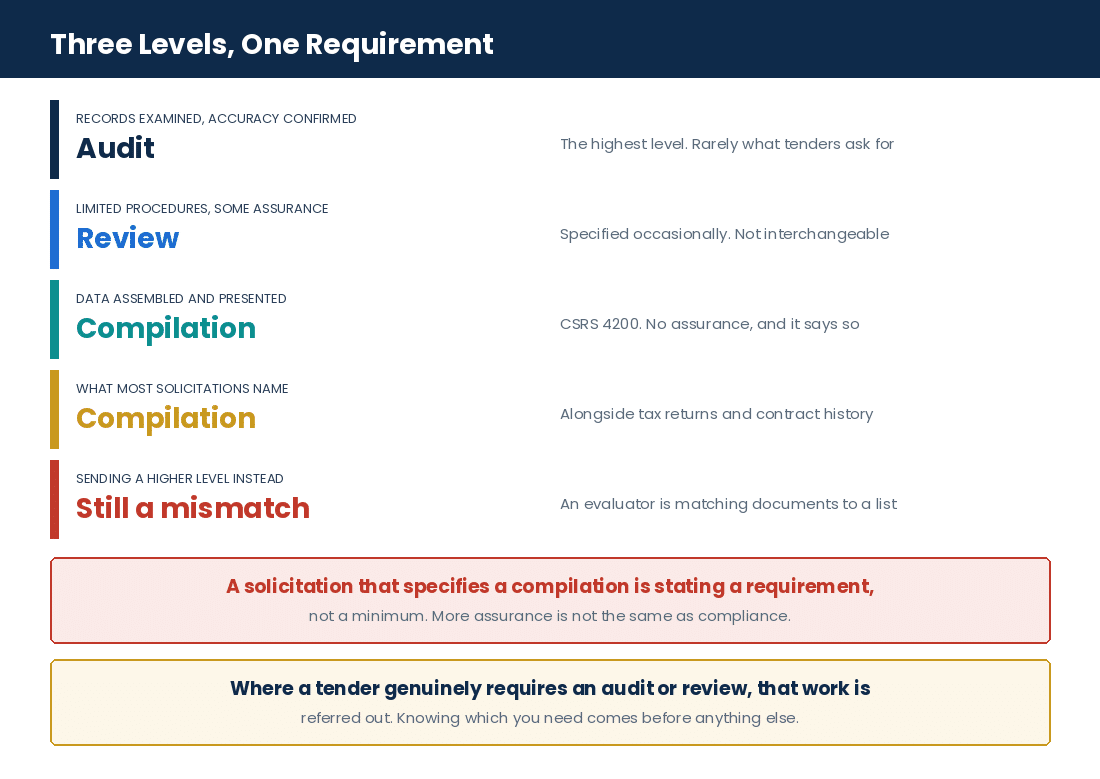
Difference from Audit and Review Engagements
A CPA compilation report does not promise the financial facts are correct. Audits check records carefully and confirm accuracy. Reviews give some assurance by looking at data in a limited way. But compilations just organize and show data as it is. No one checks if it’s right here; that’s why people call it “no assurance.”
This matters when replying to requests for proposals (RFPs). Some contracts need audits or reviews, while others accept compilations only.
The instinct that causes the most damage here is the one that feels most sensible: if they asked for a compilation, surely an audit is better.
It is not better, it is different, and a solicitation that specifies a compilation is specifying a compilation. Sending a higher level does not demonstrate diligence to an evaluator working through a mandatory checklist — it reads as a document that does not match the requirement. Figures changed for privacy.
Importance in the Context of Government Tenders
Government groups ask for compilation reports because they are part of must-have money papers during buying processes. These reports help check if bidders meet key rules before they get contracts. If a bidder does not send a good compilation report on time, their bid might be dropped without review—no second chances later.
These reports also help check if vendors are financially steady. They let government people see if contractors have enough resources and skills to finish projects well.
Role in Assessing Vendor Financial Stability
When looking at bids, agencies use info from compilation reports plus other papers like tax returns or past public contracts. This helps them decide if vendors can handle contract tasks during the whole project.
To sum up, knowing what a CPA Compilation Report is—and why it matters—helps businesses aiming for government contracts across Canada.
Key Requirements for Financial Statements in Government Tenders and RFPs
Key Requirements for Financial Statements
Pass or Fail
When you apply for government tenders in Canada, you often need to send financial statements made under certain rules. A CPA Compilation Report for government tenders is usually asked for. This report shows your financial status but does not give any guarantee or assurance. These compiled statements help the government check if a vendor qualifies, making things fair and clear.
Typical Financial Statement Requirements in Canadian Government Procurement
In Canada, government buying documents tell you exactly what kind of financial statements they want. You must give compilation reports or compiled financials that cover certain times, businesses, and accounting methods they say.
Here’s what they often ask for:
- Level of Engagement: Most bids want a CPA Compilation Report for government tenders. This means just putting together past info without audit or review checks (CSRS 4200). The report also has a note saying how numbers were made.
- Periods Covered: Usually, they want two to three years of yearly or part-year compiled statements. The exact years depend on the bid deadline and business setup.
- Entity Specification: Statements must come from the company bidding only — no combined group reports unless the tender says it’s okay.
- Supporting Records: Behind each report are detailed files like trial balances, ledgers, bank records, and tax papers that back up the numbers.
For example, an RFP might say: “Send compiled financial statements with a CPA Compilation Engagement Report for fiscal years ending December 31 of the last two full years.” This makes it clear what bidders must provide.
Compliance Expectations
You must follow these rules closely because many are pass-or-fail. If you don’t submit exactly what’s asked — like missing years or wrong report types — you can get kicked out with no chance to fix it after bids close.
Here’s what you must watch:
- Match Solicitation Exactly: Your compilation report must be at the level requested. Don’t send an audited or reviewed one if they only want a compilation.
- Submit On Time: Late files don’t count, no matter how good they are.
- No Extra Docs: Only send what is asked. Adding extra papers can cause confusion or reveal info you don’t want to share since bids become public records under transparency laws (CRA Requirement, CSRS 4200).
- Known User Rule: If the government agency is named as a known user under CSRS 4200 rules, compilations can include restricted use letters confirming this.
Following these rules helps avoid problems with non-compliance and keeps evaluations fair across Canada’s procurement system.
Sending incomplete or wrong-labeled compilation reports for mandatory needs leads to your bid not being looked at.
The “no extra documents” instruction is the one bidders most often override, usually out of generosity.
A firm sends five years rather than two because it has them, or adds a bank letter nobody requested. Beyond cluttering the submission, bid documents can become public records, so material you were never asked for can end up disclosed. The discipline is to send precisely the list, and nothing adjacent to it. Figures changed for privacy.
For help making CPA Compilation Reports that meet government tender rules in Canada (including Ontario areas like Hamilton), contact Gondaliya CPA at info@gondaliyacpa.ca or call 647‑212‑9559 today.
The Compilation Engagements Standard (CSRS 4200) and Its Impact on Government Contract Financial Statements
The CSRS 4200 Standard and Its Impact
The Standard
Overview of CSRS 4200 Compilation Engagements Standard
The CSRS 4200 standard tells CPAs how to do compilation engagements in Canada. It sets rules for making a CPA Compilation Report for government tenders and other financial statements. In this work, CPAs prepare the reports using info from the business. They don’t check or give any assurance about the numbers.
When a business wants to bid on government contracts, CSRS 4200 guides how to make a compilation report for RFP Canada that fits official rules. The report must say it gives no assurance. It also needs a note about the accounting method used.
This standard lets some compiled statements be accepted at certain levels asked for by bids. But it never allows calling them audited or reviewed reports. CPAs have to follow clear rules so readers know what the report covers and what it doesn’t.
Implications for Government Contracts
In Canada, many government contract financial statements must follow CSRS 4200 if bidders send compiled reports. One big thing is if the government body asking for bids counts as a “known user.” If yes, special engagement letters and notes explain who can use these reports.
Compiled statements need a note on the basis of accounting. This explains if they used cash or accrual methods or something else. This helps meet what the bid asks for.
It’s also key to know the difference between mandatory and rated requirements:
- Mandatory requirements are must-haves. Missing them means disqualification.
- Rated requirements get you points but won’t knock you out if missing.
Knowing this helps bidders set up their compilation right and not mess up with wrong levels or incomplete data.
Using CSRS 4200 keeps your government contract financial statements Canada correct with both CPA rules and bid rules.
Known user status is the detail worth raising with your accountant on the first call rather than the last.
It changes the engagement letter and the wording of the report itself, so it is not something that can be bolted on once the statements are finished. Naming the public body correctly at the outset costs nothing. Discovering it after the report is signed means producing the report again. Figures changed for privacy.
Tender Submission Readiness Check
Five quick questions on whether your submission will survive screening. No fee shown.
Points to raise with us:
This is a general prompt, not tax or legal advice or a quote. Your position depends on your full facts. For a real review, please book a free consultation.
Preparing Compiled Financial Statements to Meet Government Procurement Criteria
Preparing Compiled Financial Statements
The Process
When you want to bid on government tenders and RFPs in Canada, you often need a CPA Compilation Report for government tenders. These reports show financial statements for government tenders Canada. Licensed Ontario CPA firms prepare them using set rules. The report shows the numbers fairly based on accounting records like trial balances. But it doesn’t give any guarantee or assurance.
Steps for CPA Firms and Applicants
Making financial statements for government tenders Canada starts with collecting good accounting records. Licensed Ontario CPA firms take info like trial balances and ledgers. They use CSRS 4200, the Canadian compilation engagement standard, to compile the reports. This means they:
- Look over the client’s data without auditing or reviewing.
- Make sure all needed periods and entities named in the documents are included.
- State clearly that no assurance is given on the numbers.
- Write a basis of accounting note that says how they prepared the numbers.
Applicants have to give complete and neat bookkeeping data first. Clear talks about what the tender wants help avoid mistakes or missing info.
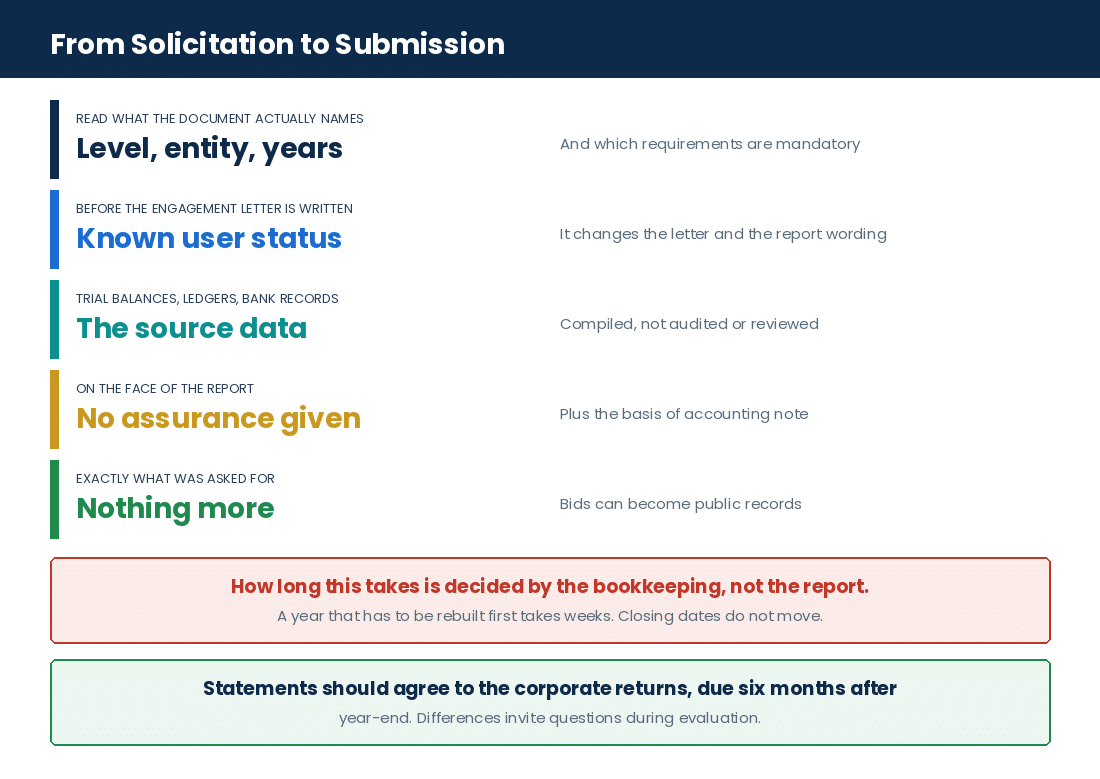
Process Workflow for Preparing Reports
The work begins when an applicant asks a licensed Ontario CPA firm for a compilation engagement. Steps include:
- Engagement Acceptance: Check if the compiled financial statements match levels accepted by procurement (usually no assurance).
- Known User Acknowledgment: Find out if the public body is a known user under CSRS 4200 rules; this changes report wording and notes.
- Compilation Engagement Report Preparation: Make a report saying no assurance is given on the statements.
- Basis of Accounting Note Inclusion: Add notes explaining how transactions were recorded (like cash or accrual basis).
This way keeps things right with professional standards and government contract financial statement requirements Canada.
How long a compilation takes is decided almost entirely by the state of the bookkeeping, not by the report.
Where the trial balance reconciles and the bank records are complete, the work is days. Where the year has to be rebuilt first, it is weeks, and closing dates do not move to accommodate that. Firms that bid regularly keep the books current for this reason alone. Figures changed for privacy.
Tailoring Compilation Reports for Specific Tenders and RFPs
Each tender or RFP can ask for special things about which entity’s finances to show, what time periods to cover, and if rules are mandatory or just rated.
To make reports fit right:
- Use exact entities named in solicitation documents; don’t swap parent companies unless allowed.
- Show only fiscal years or months asked by procurement authorities.
- Know which requirements are mandatory (fail means disqualification) versus rated (scored during review).
Say an RFP wants two full fiscal years’ compiled financials from a joint venture started last year. Then prepare part-year statements but check with procurement contacts before deadline.
A newer entity cannot produce history it does not have, and nothing a CPA does will change that. What can be done is asking the procurement contact how they want the gap handled, in writing, well before closing. The question itself is never held against a bidder. Figures changed for privacy.
Making reports this way cuts risks of rejection from not following rules. It also meets transparency laws across Canada including Ontario [CRA Filing Requirements] [CSRS 4200].
Documentation and Disclosure Obligations in Compilation Reports for Government Bids
Documentation and Disclosure Obligations
What Must Appear
When you bid on government contracts, your CPA Compilation Report for government tenders must follow certain rules. These rules make sure the financial statements are clear and honest. Government bodies across Canada want to see accurate info before choosing a bidder. Knowing these rules helps you prepare proper financial statements for government tenders Canada that meet those needs.
Mandatory Disclosures Under CSRS 4200
CSRS 4200 is a Canadian rule for compilation engagements. It tells how reports should be made for bids.
You must include a basis of accounting note. This note says if the numbers use cash basis, accrual basis, or another method like ASPE (Accounting Standards for Private Enterprises). It explains how the money was counted.
You also have to say if there is a known user engagement. For a CPA Compilation Report for government tenders or an RFP in Canada, this means who will use the report—usually a government group. Knowing the user changes how you explain limits on the report.
The standard also says the report can’t promise accuracy or completeness. It must clearly say it does not give audit or review-level assurance. The wording can’t be changed to sound stronger than a compilation.
These points protect bidders and governments by making sure everyone knows what the compiled financial data really shows.
- Tell which accounting method was used.
- Name who will see and rely on the report.
- Say no assurance is given on numbers.
- Use exact standard wording only.
Recordkeeping and Supporting Documentation
You need to keep good records that back up your compiled statements. This helps later if someone checks your work.
Keep all financial documents at least six years after filing, as CRA says (CRA Retention Requirements). This covers audit and review needs during procurement checks.
Your government contract financial statements Canada must match what you file in your corporate tax returns with CRA. Usually, returns are due six months after your fiscal year ends. If numbers differ, auditors or reviewers may ask questions.
After sending these reports to a public body with your RFP, they become part of public records in some cases. Only send exact copies of what’s asked—no extra papers—to avoid privacy troubles because governments might share info under access laws.
Good recordkeeping plus following CSRS 4200 disclosure rules helps avoid getting kicked out of bidding for missing papers or mismatched info.
- Keep records 6+ years post-filing.
- Make sure tax returns and statements match exactly.
- Only send requested documents with your bid.
- Watch out: don’t submit reviewed/audited reports if only compilations allowed.
- Ask your CPA early about known user status.
- Clear basis notes build trust but don’t claim more assurance than allowed.
Financial statement retention period minimum six years per CRA.
Statements submitted must match corporate tax returns filed timely.
Submitting reviewed/audited level when only compilations allowed leads to set-aside.
Confirm known user status early with your CPA before starting engagement.
Our Take: Clear basis notes build trust without implying unrequired assurances.
The basis of accounting note is the most useful paragraph in the whole report and the one most often treated as boilerplate. An evaluator reading cash-basis figures who expected accrual has a question. An evaluator who can see on the page which method was used does not. Figures changed for privacy.
CSRS 4200 now demands even clearer known-user ID and forbids changing compilation reports into higher-assurance types after filing.
Resources, Tools, and Quality Management Standards Relevant to CPA Compilation Engagements in Canada
Resources, Tools and Quality Management
Standards and Support
Available Guidance and Support
If you’re getting a CPA Compilation Report for government tenders, you need clear info on financial statements for government tenders Canada. The compilation report for RFP Canada shows what financial data bidders must share. These reports don’t give assurance but show a company’s financial status. Government agencies expect these reports in certain formats. Without that, your bid might not count.
CPA Canada Publications and Tools
CPA Canada created CSRS 4200. It tells how to handle compilation engagements in provinces like Ontario. Licensed Ontario CPA firms, such as Gondaliya CPA, follow it closely when making reports for government tenders. CSRS 4200 guides how to prepare and show compiled financial statements without giving audit opinions. Firms registered with CPA Ontario use official tools and training to keep their work up to standard.
Relevant Templates and Checklists
A compilation engagement usually needs some key papers:
- A compilation engagement report that says no assurance is given
- A basis of accounting note explaining the methods used
- An acknowledgment from known users who get the report
These templates help make clear what was done during the work. They also meet government request rules. Checklists make sure nothing is left out before you send your papers.
| Document | Purpose |
|---|---|
| Compilation Engagement Report | States no assurance given |
| Basis of Accounting Note | Explains accounting methods used |
| Known-User Acknowledgment | Confirms who will use the compiled statements |
Quality Control and Assurance
Making quality CPA Compilation Reports for Government Tenders means following CSRS 4200 rules exactly. This keeps reports consistent and clear, which matters a lot for public contracts in Canada. Following these rules lowers the chance your bid gets dropped because of missing or wrong papers. Licensed firms do internal checks that match professional standards before finishing any tender report.
Standards of Practice for CPAs
Only licensed CPA firms can handle compilation engagements on government tenders now in Canada. These firms must stay independent from client decisions about money matters while showing financial data correctly but with no audit or review guarantees. They must follow CSRS 4200 rules fully. Sticking to these rules protects both bidders and public trust during the bidding process.
Ongoing Professional Development
Gondaliya CPA keeps skills sharp by learning about changes like the 2026 updates to CSRS 4200 standards. They hold US CPA licenses from Washington State and Montana too, which gives them extra knowledge across borders. But this doesn’t change how they work with Canadian government tender rules involving compiled financial info only.
Sharad Gondaliya leads at Gondaliya CPA, making sure staff know about new rules that affect compilation engagements everywhere including places like Hamilton, Ontario.
The three documents in that table are not paperwork around the engagement. They are the engagement.
A compilation report without a basis of accounting note is incomplete. One without the known-user acknowledgement, where a public body is named, does not say who may rely on it. Firms that treat these as a cover sheet are the ones who find out at evaluation that something was missing. Figures changed for privacy.
Frequently Asked Questions (FAQs)
Frequently Asked Questions
Answers
What is the known user engagement requirement in compilation reports?+
When is the corporate tax return filing deadline for bidders?+
How long must I keep financial statement records for government tenders?+
What happens if I miss the typical bid closing absolute deadline?+
What levels of compilation engagements are accepted in government tenders?+
Can I submit an audited or reviewed report instead of a compilation report?+
How does Gondaliya CPA help with vendor qualification for government contracts?+
What is the basis of accounting note in a compilation engagement report?+
Essential Points and Key Terms
Key Points
Essential Points on Compilation Report Requirements for RFP Canada Submissions
- Always follow CSRS 4200 standards when preparing reports for government tenders in Canada.
- Submit only requested documents; avoid extra papers to comply with access to information laws.
- Confirm if the public body is a known user to include proper disclaimers and letters in your report.
- Ensure financial statements match filed corporate tax returns as per Income Tax Act regulations.
- Use licensed CPA firms experienced in compilation-only engagements to avoid errors and delays.
- Meet all mandatory requirements strictly; missing these leads to immediate bid disqualification.
- Understand rated requirements can add points but won’t eliminate your bid if missing.
- Know absolute deadlines for bid closing; late files won’t be accepted or reviewed.
- Maintain neat records to support your compiled statements during CRA reviews or audits.
- Choose a CPA firm familiar with Ontario procurement authorities and government contract financial standards.
Businesses that bid often eventually stop treating each submission as a project.
The statements get compiled on a schedule rather than on demand, the entity and basis stay consistent year to year, and the only thing that changes per tender is which years are pulled and whether the known user differs. That shift — from reactive to routine — is what separates firms that bid comfortably from firms that dread it. Figures changed for privacy.
Key Terms Explained
- Standing Offer: A contract allowing multiple orders over time based on set prices and terms, requiring up-to-date financials for qualification.
- Bid-ready business: A company whose financials meet all tender criteria and deadlines for smooth submission process.
- Compilation engagement letter: A formal agreement between CPA and client specifying scope and user limitations of the compilation work.
- Assurance practitioner: A CPA providing audit or review services; not involved in compilation-only reports that provide no assurance.
Contact Gondaliya CPA at info@gondaliyacpa.ca or call 647‑212‑9559 for expert assistance in preparing compliant financial statements and CPA Compilation Reports tailored for Canadian government tenders and RFPs.
Businesses We Serve & Industry Spotlights
Industry Expertise
Government procurement reaches a particular set of trades, and the questions that decide whether a bid is evaluated — is the engagement at the level asked for, does it cover the right entity and years, and is it in on time — recur across every one of these sectors.
| Industry | The Tender Angle |
|---|---|
| Security guard companies | Standing offers for sites, renewed on current financials |
| Security companies | Vendor qualification repeated across several agencies |
| Construction project management firms | Financial capacity tested against contract size |
| Engineering consultants | RFPs with mandatory and rated requirements side by side |
| Environmental consultants | Public sector work that is almost entirely tendered |
| Land surveying companies | Municipal and provincial rosters needing annual statements |
| IT staffing companies | Supply arrangements with recurring financial submissions |
| Administrative service businesses | Smaller contracts with the same compliance mechanics |
| Building supply companies | Standing offers priced over a multi-year term |
| School bus operators | Board contracts where financial stability is scrutinised |
| Courier companies | Agency-wide delivery contracts bid on fixed cycles |
- Security guard companies: Among the most frequent bidders for public work, often holding standing offers that need current compiled statements at each renewal.
- Security companies: Vendor qualification repeats across several agencies, each with its own list, which is where consistency in the reporting entity matters.
- Construction project management firms: Financial capacity is weighed against the size of the contract, so the statements are read rather than filed.
- Engineering consultants: RFPs here typically mix mandatory and rated requirements, and knowing which is which decides where effort goes.
- Environmental consultants: A sector where public sector work is close to entirely tendered, so the submission process is the business development process.
- Land surveying companies: Municipal and provincial rosters that need statements refreshed annually to stay qualified.
- IT staffing companies: Supply arrangements come with recurring financial submissions, which makes a repeatable annual process worth building once.
- Administrative service businesses: Smaller contracts carry exactly the same compliance mechanics as large ones, with no allowance made for size.
- Building supply companies: Standing offers priced over a multi-year term, where financial stability over the period is the point of the review.
- School bus operators: Board contracts where financial capacity is examined closely, because service interruption is not an acceptable outcome.
- Courier companies: Agency-wide delivery contracts bid on fixed cycles, which makes the submission calendar as important as the pricing.
In every one of these, the financial statements are rarely why a bid fails. The packaging is.
Wrong engagement level, the parent company instead of the bidding entity, three years when two were asked for, a missing basis of accounting note, or an hour past closing. None of those are accounting problems, and all of them end the bid before anyone reads a number.
Professional Guidance and Quick Reference
Guidance
Essential Points for Bidders Preparing Compilation Reports
Bids are set aside for a predictable set of reasons, and almost none of them involve the figures: sending an audited or reviewed report where the solicitation specified a compilation; submitting the parent company’s statements rather than the bidding entity’s; covering two years when three were named, or the wrong year-ends; omitting the basis of accounting note or the statement that no assurance is provided; not naming the public body as a known user when it is one; adding documents nobody asked for, which can end up on the public record; statements that do not agree to the corporate returns filed with CRA; and arriving after the closing time. Gondaliya CPA prepares compilation engagements under CSRS 4200 on a flat fee.
Quick Answers
At a Glance
- What a compilation is: financial information assembled from management’s records, with no assurance given
- The standard: CSRS 4200, the Canadian compilation engagement standard
- Audit: examines records and confirms accuracy
- Review: limited procedures giving some assurance
- Compilation: organises and presents the data, and says so on its face
- Match the level requested: a higher level than asked for can disqualify, not impress
- Entity: the bidding company only, unless the tender permits group statements
- Periods: commonly two to three fiscal years, exactly as the solicitation names them
- Required on the report: no-assurance wording, basis of accounting note, known-user acknowledgement where applicable
- Basis of accounting: cash, accrual or another framework such as ASPE, stated plainly
- Known user: the public body named in the engagement letter, restricting who may rely on the report
- Mandatory requirements: missing one means disqualification
- Rated requirements: scored, but not fatal if absent
- Deadlines: absolute; late submissions are rejected without review
- Extra documents: do not send them; bids can become public records
- Agreement to tax filings: statements should match the corporate returns, due six months after year-end
- Records: trial balances, ledgers, bank records and tax papers, kept at least six years
- 2026 update: clearer known-user identification, and no converting a compilation to a higher assurance level after filing
Who This Is For / Not For
Fit Check
- For: Canadian businesses bidding on government tenders, RFPs and standing offers that require compiled financial statements as part of vendor qualification.
- For: firms already on a roster who need statements refreshed each year, and newer entities working out how to present a short trading history.
- Not for: advice on procurement law, bid protests, contract terms or how a particular solicitation will be scored, which sit with procurement advisers and counsel.
- Not for: bidders whose solicitation requires an audit or review, which Gondaliya CPA refers out. A business that has never bid before is squarely in scope — the mechanics are the same at any size.
People Also Ask
Related Questions
They asked for a compilation. Won’t sending an audit look better?+
No, and it can cost you the bid. A solicitation that specifies a compilation under CSRS 4200 is stating a requirement, not a minimum. An evaluator working through a mandatory checklist is matching documents to the list, and a report at a different level does not match. Send the level named.
What does “no assurance” actually mean to the agency reading it?+
That the CPA assembled the information from management’s records without auditing or reviewing it. The report says so explicitly and the wording cannot be softened to imply more. Agencies know this and ask for compilations anyway, because what they want is consistently prepared financial information alongside tax returns and contract history.
Our company is new. We don’t have two full years. Now what?+
Prepare part-year statements for the period that exists, and ask the procurement contact in writing how they want the shortfall handled — well before closing. The question is routine and is not held against bidders. What does cause problems is deciding the answer yourself and submitting something the solicitation did not contemplate.
Can I submit the parent company’s statements instead?+
Only if the tender says so. The default is that statements come from the bidding entity alone, not a combined group. Substituting a parent because its figures are stronger is one of the more common reasons a submission is set aside, and it is not something that can be corrected after bids close.
Why would sending extra documents hurt us?+
Because bid submissions can become public records under access to information legislation. Material you were never asked for can end up disclosed along with everything else, and it adds noise to a submission being checked against a list. Send exactly what is requested and nothing adjacent to it.
Glossary of Key Terms
Definitions
- Compilation engagement: work in which a CPA assembles financial information from management’s records without providing assurance.
- CSRS 4200: the Canadian Standard on Related Services governing compilation engagements.
- Compilation engagement report: the report accompanying compiled statements, stating that no assurance is provided.
- Basis of accounting note: the note explaining the framework used, such as cash, accrual or ASPE.
- Known user: a named party, often the public body, identified as a user of the compiled statements.
- Known-user acknowledgement: the document confirming who may rely on the compiled information.
- Compilation engagement letter: the agreement setting out the scope of the work and the limits on its use.
- Assurance practitioner: a CPA providing audit or review services, not involved in compilation-only work.
- Mandatory requirement: a solicitation requirement that disqualifies a bid if unmet.
- Rated requirement: a requirement that earns points in scoring but does not disqualify.
- Standing offer: an arrangement allowing repeat orders over time on set prices and terms.
- Vendor qualification: the process by which an agency establishes a bidder is capable of performing.
- Bid-ready business: a company whose financials meet the tender criteria and deadlines without scrambling.
- Solicitation: the tender, RFP or request document setting out what bidders must provide.
- Set-aside: a bid removed from evaluation for failing a mandatory requirement.
Want a checklist to work from? You can download our free government tender compilation checklist before your consultation.
Four things decide whether your financial submission survives evaluation. The level — a compilation under CSRS 4200 where a compilation is specified, because an audited or reviewed report in its place can set the bid aside just as a missing one would. The entity and the periods — the bidding company alone unless the tender permits otherwise, for exactly the fiscal years named, usually two or three. What appears on the report — the explicit statement that no assurance is provided, the basis of accounting note identifying cash, accrual or ASPE, and the known-user acknowledgement where the public body is named, which has to be settled before the engagement starts rather than after. And the discipline around it — nothing beyond what was requested, because bids can become public records; statements that agree to the corporate returns due six months after year-end; records kept six years; and submission before an absolute deadline.
Three questions tell you where you stand, and the solicitation answers all of them. First, what engagement level does it name, in those words? Compilation, review and audit are different products and the document will say which. Second, which entity and which fiscal years? Write them down exactly as printed, because a parent company or an extra year is a set-aside rather than a detail. Third, is the agency named as a known user? That answer changes the engagement letter and the report wording, so it belongs in the first conversation with your CPA and not the last.
Financial Statements for Government Tenders Canada: How Gondaliya CPA Can Help
Start with the solicitation itself and your bookkeeping records
Gondaliya CPA reads the solicitation first and confirms the engagement level, entity and periods it actually names, establishes known user status before the engagement letter is written, compiles the statements under CSRS 4200 from your trial balances and ledgers, includes the no-assurance wording and a basis of accounting note that says plainly which framework was used, checks the figures agree to the corporate returns filed with CRA, and hands you exactly the documents the tender asked for and nothing more — on a flat fee with a one-business-day response. Compilations are what we do; where a solicitation requires an audit or review, we tell you at the outset and refer it out. Please book a free consultation.
Next Steps
Please book a free consultation with Gondaliya CPA and bring three things: the solicitation document itself, your bookkeeping records for the years it names, and the closing date. Those three settle the engagement level, the entity and periods, and whether there is time to do it properly — which between them account for nearly every submission we see set aside. If the tender requires an audit or a review rather than a compilation, say so at the outset and we will tell you straight away and refer it out, because that is not work we do. If the closing is days away rather than weeks, say that too, because it changes what is realistic. You will get a flat fee before any work begins. We serve Toronto, Mississauga, Brampton, Vaughan, Etobicoke, Scarborough, Hamilton, Ottawa and the rest of Ontario, and work with bidders across Canada. If our content helps, please add gondaliyacpa.ca as a preferred source on Google.
Published: · Last updated:
Editorial policy: We research against CRA, Department of Finance, Parliament of Canada, CPA Canada and CPA Ontario sources, fact-check the figures, and Sharad Gondaliya, CPA, reviews the content, which we update as the rules change.
Disclaimer: This article is educational information only and is not tax, legal, financial or procurement advice. It covers compilation engagements under CSRS 4200 as they are used in Canadian government procurement, and it does not cover procurement law, bid protests, contract terms, or how any particular solicitation will be evaluated or scored, each of which is handled separately. Professional standards, retention periods and filing deadlines change, and the source material refers to a 2026 update to CSRS 4200 and states that only licensed CPA firms may perform these engagements; every requirement should be confirmed against the current standard, against CPA Ontario guidance and above all against the wording of the solicitation itself, which governs what a bidder must provide. Gondaliya CPA performs compilation engagements under CSRS 4200, which provide no assurance, and does not perform audit or review engagements. Please consult a licensed CPA before acting.

Sharad Gondaliya is a CPA Canada & CPA USA with 15 Years+ experience of Accounting, Tax, Payroll of Corporate Small Businesses as Tax Accountant. He is a CPA Ontario member (61040184) and holds US CPA licences in Washington and Montana and is well known among corporate small businesses for tax planning, efficient tax solutions, and affordable CPA services. Sharad is the Principal (Director) of Gondaliya CPA – Affordable CPA Firm in Canada. Licenses: CPA Ontario: 61040184 | CPA USA (MT): PAC-CPAP-LIC-033176 | CPA USA (WA): 57629 | CPA Firm License: 61330051 View Full Author Bio