



Human Resource Consultant Tax Deductions in Canada: Professional Memberships, Training & Certification Costs
HR Consultant Tax Deductions Canada: Business Expenses and Write-Offs
For human resource consultant tax deductions Canada, understanding HR consultant business expenses and tax write-offs is essential to reduce taxable income legally. Gondaliya CPA explains how professional memberships, training costs, certification expenses, and other consulting business deductions affect your filings.
Quick Summary
Most of what an HR consultant deducts is governed by two sentences: profit is computed under subsection 9(1), and paragraph 18(1)(a) denies anything not incurred to earn income, with section 67 adding that the amount must be reasonable. The complications sit in four places. Conventions are capped at two a year by subsection 20(10), with no exception for a good reason and a requirement that the location suit the organisation’s territorial scope. Training splits on the lasting-benefit test in IT-357R2: a course that maintains an existing skill is deducted now, one that confers a new qualification is capital and falls into Class 14.1 at five per cent. Bundled membership invoices need splitting, but the insurance portion is not lost — it moves to the insurance line, and a charitable portion supports a credit under section 118.1. And the home office test in subsection 18(12) gives two alternatives, of which being your principal place of business is the one most consultants meet. If you are incorporated, the personal services business rules in subsection 125(7) matter more than any deduction on this page, and they turn on employee-like facts rather than on any percentage of revenue.
Reading time: 16 minutes.
Table of Contents
- Core Principles and Eligibility
- Deductible Expenses, Category by Category
- Training, Certification and Memberships
- Non-Deductible Expenses and Common Pitfalls
- Documentation and Audit-Proof Records
- Filing, Forms and Deadlines
- Frequently Asked Questions
- Essential Points for HR Consultants
- Businesses We Serve & Industry Spotlights
- Professional Guidance and Quick Reference
The Numbers That Matter
This article covers Canadian federal income tax and GST/HST for human resource consultants resident in Canada, with Ontario and Toronto context, and reflects rules current to 2 November 2026. It is written for sole practitioners filing Form T2125 and for incorporated consultancies filing a T2, and it covers the purpose and reasonableness tests, current versus capital expenses, professional memberships and bundled dues, training, certification and examination fees, conventions, the work space in the home, vehicle and travel costs, meals, equipment and software, subcontractor payments, GST/HST registration, record keeping and the personal services business rules. It concerns the consultant’s own tax position, not advice they give clients: employment standards, pay equity, human rights compliance, payroll administration for client workforces and the design of benefit plans are all outside it. Gondaliya CPA performs compilation engagements under CSRS 4200, which provide no assurance; audit and review engagements are referred out. This is educational information only and not tax or legal advice.
Core Principles and Eligibility
Foundations
Tax Write-Offs for HR Consultants: Core Principles and Eligibility
If you are an HR consultant in Canada, understanding tax deductions matters. Human resource consultant tax deductions in Canada reduce your taxable income by letting you write off certain business costs. The main rule is short: the expense has to serve the purpose of earning income. If it does not, it usually will not qualify.
The Rule Under Canadian Tax Law
Profit is computed under subsection 9(1), and paragraph 18(1)(a) denies anything not incurred for the purpose of gaining or producing income from the business. Section 67 adds a second filter: the amount must also be reasonable in the circumstances. Both have to be satisfied. A cost can be genuinely business-related and still be cut back because the amount is out of proportion to what the work required.
For HR consultants the practical consequence is that the tie to consulting work has to be visible in the record, not just in your head. Two particular limits apply:
- Professional memberships related to HR are deductible where you pay them to earn income from the consulting practice
- Subsection 20(10) allows the expenses of attending not more than two conventions in a year, and the limit is absolute — there is no exception for a good business reason. The convention must also be held by a business or professional organization at a location consistent with that organization’s territorial scope, which is what disallows a Canadian association’s convention held somewhere warm
A consultant in Toronto attended four conferences in one year — two national HR conventions, a regional one and a specialist compensation summit — and claimed all four, about $9,400 including travel. She had read somewhere that the limit could be exceeded with a business justification and had written a careful memo explaining why each was necessary. The memo made no difference, because subsection 20(10) does not contain an exception for it. We claimed the two most expensive, roughly $5,800, and removed the rest. The right time to have that conversation is in February when the registrations open, not in April when the return is being prepared. Figures changed for privacy.
How HR Consultant Business Expenses Affect Taxable Income
Your business expenses come in several types — training programmes, professional memberships, office supplies, software, travel — and claiming them properly lowers your taxable income.
The division that causes most difficulty is current against capital:
- Current expenses: consumed in the ordinary course, such as office supplies or a software subscription you use month to month. Deducted in the year incurred.
- Capital costs: something with a lasting benefit, such as equipment, or a qualification that opens new work to you. Recovered over time through capital cost allowance rather than deducted at once.
Knowing which side a cost falls on is most of getting an HR consultant’s return right, and section three deals with the hardest case: training.
Deductible Expenses, Category by Category
Deductions
HR Consultant Business Expenses You Can Claim
Home Office Expenses
Subsection 18(12) offers two routes and you need only one. Either the work space is your principal place of business — which is the limb most consultants meet, because the proposals, the reports and the invoicing all happen there — or it is used exclusively to earn business income and used on a regular and continuous basis for meeting clients.
The exclusivity requirement belongs to the second limb only, and it travels with a meeting requirement that most HR consultants do not satisfy, since client work happens on the client’s site. Consultants routinely abandon a perfectly good claim because they have only read about exclusivity.
You can claim a share of rent, utilities, property taxes, insurance and maintenance, apportioned on the area of the workspace against the whole home. Guide T4002 sets this out for the self-employed. Two limits apply: the deduction cannot create or increase a loss from the business, and any amount disallowed on that basis carries forward indefinitely against future income from the same business.
A consultant claimed her whole home as a 30 per cent business-use space because she worked at the kitchen table, the sofa and a desk in the bedroom depending on the day. There was no identifiable work space, which is what subsection 18(12) is about — a space, not a habit. We measured the bedroom desk area properly, which came to about 8 per cent of the house, and claimed that under the principal-place-of-business limb. The claim dropped from roughly $3,200 to $850. She was unhappy about it, understandably, and she now has a claim that will hold rather than one that would not. Figures changed for privacy.
Software, Subscriptions and Assessment Tools
Subscriptions, books and assessment instruments are deductible where they support the consulting work — psychometric tools, salary survey data, HR information system access, professional journals. The cost should match the period it covers, so an annual licence spanning two fiscal years is apportioned.
What does not qualify is reading or membership that is general interest or purely networking, unless you can show it supports earning business income. The test is the same as everywhere else: purpose, then reasonableness.
Computers, Equipment and Office Furniture
Larger purchases are recovered over time rather than deducted at once.
| Asset Type | Treatment | Notes |
|---|---|---|
| Computer hardware and systems software | Class 50 | 55% declining balance |
| Purchased application software | Class 12 | 100%, but halved in the first year by the half-year rule |
| Software subscriptions | Current expense | A recurring service fee, not an asset |
| Office furniture | Class 8 | 20% declining balance |
| Capitalised training | Class 14.1 | 5% declining balance, where a new qualification is acquired |
Two traps in that table. A subscription is not a capital asset, however large the annual bill. And Class 12 software is subject to the half-year rule, so the first-year claim is 50 per cent rather than the full 100.
Vehicle Expenses for Client Engagements
Keep a logbook recording the date, destination, purpose, odometer readings at the start and end, and business kilometres against total. The log does not produce the deduction; it establishes the business-use fraction, which is then applied to actual vehicle costs — fuel, insurance, licence and registration, maintenance, interest and capital cost allowance within the prescribed limits.
Travel on Consulting Assignments
Keep convention travel and client travel apart in your records, because they are governed differently. Convention expenses fall under subsection 20(10), with its limit of two a year and its location requirement. Travel to a client engagement is ordinary business travel under subsection 9(1), with no equivalent cap. Reasonable transportation and accommodation for the engagement days qualify; meals are tracked separately because of the limit below.
Meals and Entertainment
Subsection 67.1(1) deems the deduction to be 50 per cent of the lesser of the amount paid and a reasonable amount, and it applies to food, beverages and entertainment together. On the GST/HST side, section 236 of the Excise Tax Act requires half the input tax credit claimed on meals and entertainment to be recaptured. Keep receipts showing the date, the place and who was present.
Marketing, Website and Business Development
Website hosting, domain renewal, design work, advertising and the cost of proposal materials are deductible where they promote the consultancy. Website development that creates a lasting asset rather than maintaining an existing site may be capital, on the same lasting-benefit reasoning that governs training.
Professional Liability and Other Business Insurance
Premiums on insurance protecting the consulting practice are an ordinary business expense, deducted in computing profit under subsection 9(1). Where liability cover arrives bundled inside a membership invoice, split the invoice — but see section three, because the insurance portion is not lost, it simply belongs on a different line.
Payments to Subcontractors and Associate Consultants
Where you bring in an associate for a project, have a written agreement setting out the scope and the fee before the work starts, and keep the invoices and proof of payment. The deduction turns on subsection 9(1) and section 18: the fee is deductible where it was incurred to earn income and is reasonable. The agreement is what makes the relationship legible if anyone asks.
Accounting, Legal and Banking Fees
Fees for preparing corporate filings or GST/HST returns are ordinary business costs. Legal fees for drafting or reviewing client contracts are deductible where they relate to running the consultancy. Legal fees incurred to acquire a capital asset follow the asset instead.
Training, Certification and Memberships
The Hard Cases
Professional Development, Certification and Membership Costs
These three categories account for most of what an HR consultant spends on themselves, and all three are governed by distinctions the source material in this field usually gets wrong.
Training That Maintains Against Training That Confers
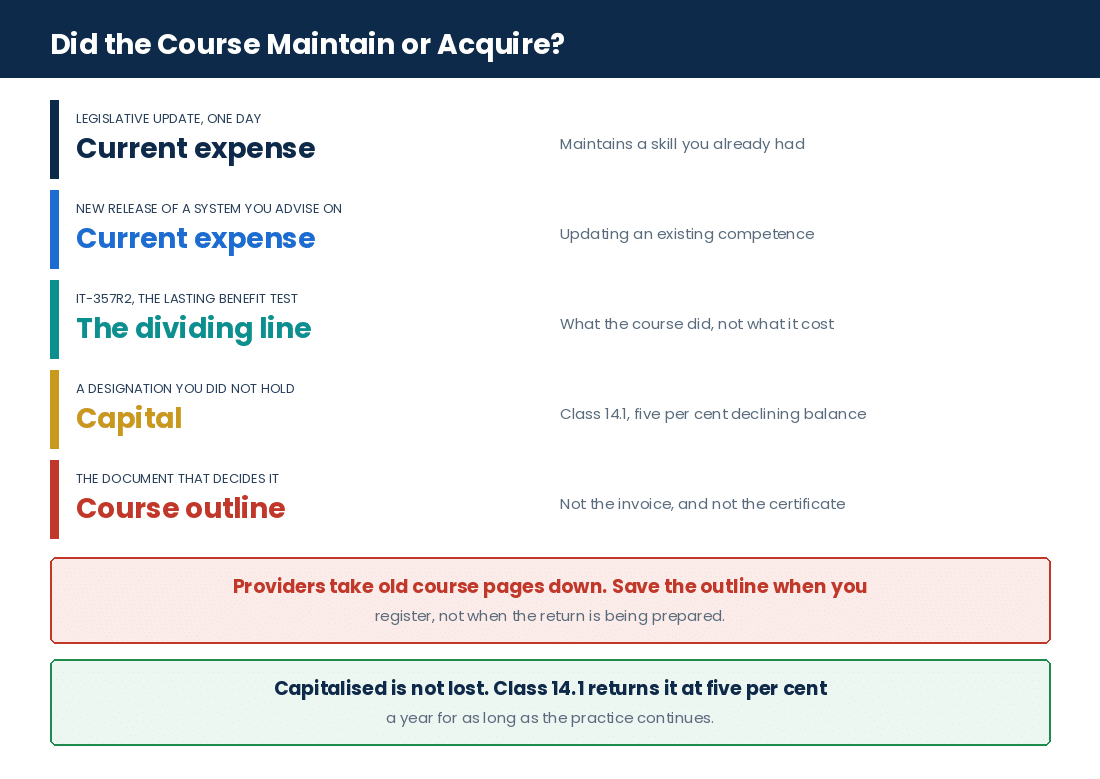
The test is in IT-357R2, Expenses of Training, and it turns on whether the training produces a lasting benefit. Training taken to maintain, update or upgrade an existing skill is a current expense, deducted in the year. Training that confers a new skill or qualification is capital.
In practice, for an HR consultant:
- A one-day session on amendments to employment standards legislation maintains an existing skill. Current.
- A workshop on a new release of an HR information system you already advise on. Current.
- A multi-year programme leading to a designation you did not previously hold, which opens work to you that was closed before. Capital.
- A conversion course taking you from generalist practice into a specialism you did not practise. Capital, on the same reasoning.
Where the cost is capital it falls into Class 14.1 at five per cent on the declining balance. It is worth being honest about how this works in practice: the test is about what the course did, not what the certificate is called, and the line between upgrading an existing skill and acquiring a new one is genuinely blurred in the middle. Keep the course outline and the learning objectives, because that is the document the question gets answered from.
A consultant in Mississauga spent about $11,000 over two years on a designation programme and deducted the whole amount in the year each instalment was paid. She had held herself out as an HR generalist for a decade; the designation did not open new work so much as formalise what she already did, which is an argument we could make and did. But the programme’s own materials described it as qualifying the holder to practise in areas she had not previously worked in, and that sentence was difficult to get past. We treated it as capital in Class 14.1, which meant about $550 of deduction in the first full year instead of $11,000. The outcome turned on a line in a brochure. Figures changed for privacy.
Examination and Re-certification Fees
Examination and re-certification fees that maintain an existing professional status are an ordinary business expense under subsection 9(1). Keep the receipt showing what the fee was for, because “exam fee” on a credit card statement tells nobody anything.
There is a second route worth knowing. Where the examination is one required to obtain a professional status recognised under a federal or provincial statute, or to be licensed or certified as a tradesperson, the fee may support the tuition credit under paragraph 118.5(1)(d) rather than a business deduction. That is a credit against tax rather than a reduction of income, it is subject to a $100 threshold per institution, and it is unavailable where an employer paid or reimbursed the fee. The two routes are alternatives, not a choice to claim twice.
Professional Memberships and Bundled Dues
Membership dues are deductible where you pay them to earn income from the consulting practice. The complication is that association invoices rarely contain only dues.
Split the invoice, but do not throw the other pieces away. This is where consultants lose money unnecessarily:
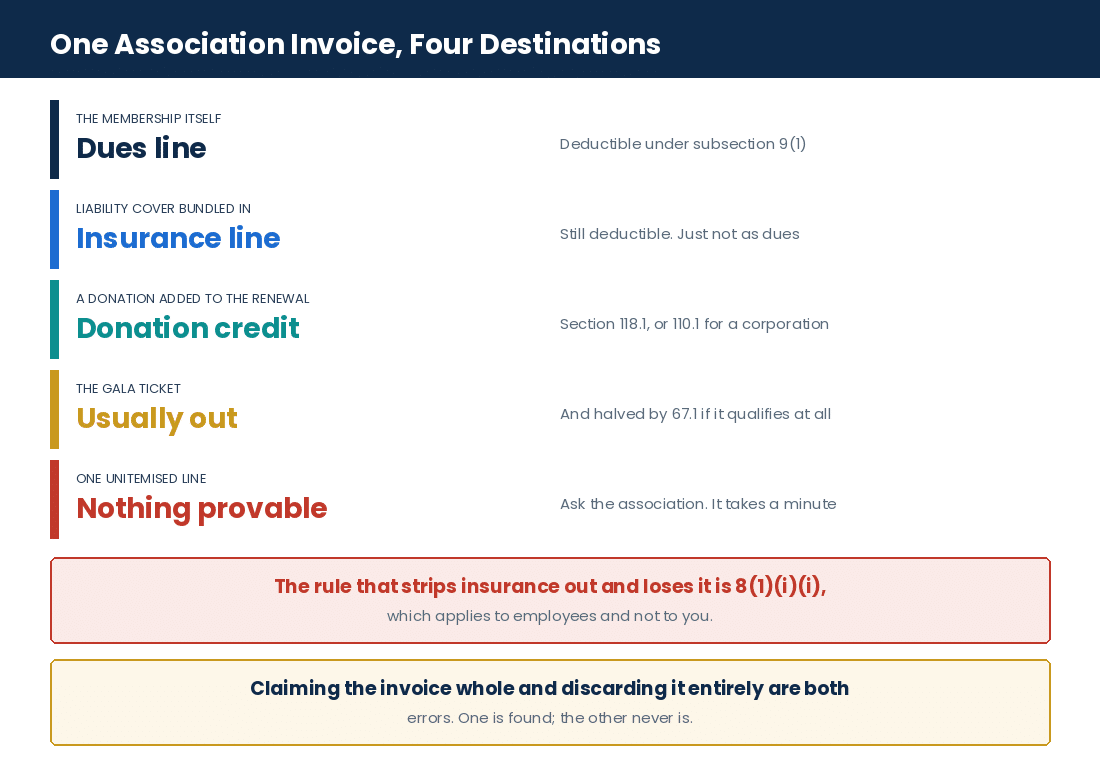
- The dues portion goes on the dues line, deductible under subsection 9(1).
- The liability insurance portion is a deductible business expense in its own right — it simply belongs on the insurance line rather than the dues line. The rule that treats the insurance component as non-dues is the employee restriction in subparagraph 8(1)(i)(i), and a self-employed consultant is not in that provision at all.
- A charitable component is not a business expense, but it is not wasted either. With a receipt it supports the donation tax credit under section 118.1 for an individual, or a deduction under section 110.1 for a corporation.
- A social or hospitality component — a gala ticket bundled into the renewal — is the piece that genuinely does come out, unless it meets the business purpose test on its own facts, in which case the meal limit applies to it.
Ask the association for an itemised invoice. Most will produce one on request, and the request takes a minute.
A client had been stripping the insurance component out of his association dues for four years and simply not claiming it, on advice he had found online. It was about $680 a year of professional liability cover bundled into a $1,450 invoice, so roughly $2,700 of deduction given away across the four years for no reason at all. The advice he had read was real advice — it is just the rule for employees claiming dues against employment income, and he is self-employed. We moved the insurance onto its own line going forward and adjusted the years still open. Figures changed for privacy.
HR Consultant Deduction Check
Five quick questions on where your deductions stand. No fee shown.
Points to raise with us:
This is a general prompt, not tax or legal advice or a quote. Your position depends on your full facts. For a real review, please book a free consultation.
Non-Deductible Expenses and Common Pitfalls
Pitfalls
Managing Non-Deductible Expenses and Common Tax Pitfalls
What HR Consultants Cannot Deduct
Some costs do not qualify however they are framed. Meals and entertainment are halved by subsection 67.1(1), so a $100 client dinner yields $50. Purely personal costs are denied by paragraph 18(1)(h), which is the provision that catches the personal portion of anything mixed. A social or benevolent component inside a bundled invoice is not a business expense, though a charitable piece can still support a credit.
If you are incorporated, the personal services business rules can restrict a great deal more than any single line item, which is the next subsection.
The Write-Off Trap: Common Errors and Misclassifications
The two tests are purpose and reasonableness, and most errors fail one of them. Beyond that, the recurring misclassifications are:
- Current against capital on training. Maintaining an existing skill is deducted now; acquiring a new qualification is capital in Class 14.1.
- Claiming a bundled dues invoice in full, rather than splitting it and putting each piece where it belongs.
- Discarding the pieces after splitting, which is the opposite error and quieter, because nothing is ever disallowed — the deduction simply never gets claimed.
- A third convention. Subsection 20(10) stops at two.
- Treating a subscription as a capital asset or expecting a full first-year write-off on Class 12 software.
Large professional development claims — several certifications, multiple conferences in one year — attract attention, and the records that answer the question are invoices, course outlines, attendance confirmations and an explanation of what each course did for existing skills.
Fixing a past year is a different exercise from getting this year right. Where previous returns claimed bundled dues in full, expensed a qualification that was capital, or ran past the two-convention limit, adjusting the open years voluntarily is materially better than waiting. It is also usually cheaper than people expect, because the corrections tend to run in both directions once the dues are split properly.
GST/HST for HR Consultants
Once your worldwide taxable supplies exceed $30,000 over four consecutive calendar quarters — or in a single calendar quarter — you cease to be a small supplier under section 148 of the Excise Tax Act and must register under section 240. This applies whether you are incorporated or not.
Below the threshold, registration is optional. The trade-off is straightforward: registering means charging tax on your fees, but it also lets you recover the GST/HST paid on training, software, equipment and professional fees through input tax credits. A consultant with heavy professional development spending and business clients who can themselves recover the tax often registers voluntarily for exactly that reason.
Keep records linking the tax charged and the tax paid to the underlying invoices by date.
A consultant stayed under the threshold deliberately for three years, turning down work in December twice to avoid crossing it, because she thought registering meant losing 13 per cent of her income. Her clients were all corporations recovering the tax in full, so the HST cost them nothing. Meanwhile she was absorbing roughly $2,100 a year of unrecoverable tax on her own software, training and equipment. Registering voluntarily would have put that back in her pocket from the start and cost her nothing in client relationships. The third December she took the work. Figures changed for privacy.
Incorporation and the Personal Services Business Rules
Incorporating changes the deduction analysis mainly because of one risk, and it is worth more attention than any expense category on this page.
The test in subsection 125(7) is not a revenue percentage. It asks whether the individual doing the work would reasonably be regarded as an officer or employee of the client but for the existence of the corporation, unless the corporation employs more than five full-time employees throughout the year or provides the services to an associated corporation. Consultants often believe there is a concentration threshold — a share of revenue from one client below which they are safe. There is not. The factors are the common-law ones: control, ownership of tools, chance of profit, risk of loss, and the intention of the parties.
Where the rules apply, three things happen together. Paragraph 18(1)(p) strips the corporation’s deductions back to roughly the salary and benefits paid to the incorporated employee plus a short list of other items — so the training, the memberships, the home office and the vehicle all go. The small business deduction is denied. And section 123.5 adds a further 5 per cent tax on the corporation’s taxable income from that business.
Filing deadlines also differ. A self-employed consultant files the T1 by 15 June, with the balance owing still due 30 April and interest running from 1 May; a corporation files the T2 within six months of its fiscal year-end. The return is due at six months but the balance is due at two — three for a Canadian-controlled private corporation that claimed the small business deduction and meets the conditions — so arrears interest can be running while the return is not yet late.
Documentation and Audit-Proof Records
Records
Documentation and Compliance for Audit-Proof Tax Claims
Record-Keeping Practices for HR Consultant Write-Offs
Every deduction needs proof. Keep invoices, receipts, contracts and payment records — particularly for associate and subcontractor payments, where the agreement is as important as the invoice.
The duty to keep records is in subsection 230(1), and subsection 230(4) sets the six-year retention period, running from the end of the last tax year the records relate to.
Keep business and personal costs apart from the outset. Sorting them in April from a mixed credit card statement is where errors enter, and where genuine deductions get abandoned because reconstructing them is too much work.
Tracking Business Use Percentages
Anything used for both business and personal purposes needs a defensible fraction behind it.
- Home office: keep a floor plan with the measurements, the utility bills, and the rent or mortgage interest statements. Write down how the percentage was arrived at, once, and reuse it.
- Vehicle: the logbook, with the purpose of each trip recorded and not just the distance.
- Phone and internet: a reasonable split, documented, rather than a round number chosen because it looked fair.
The fraction is what CRA asks about, and it is almost always the piece nobody wrote down at the time.
Proof Requirements for Particular Claims
Receipts alone often are not enough, because a receipt shows what you paid and not why. Add the document that answers the why:
- Training: the course outline and learning objectives, which is what settles the maintain-or-acquire question under IT-357R2
- Conventions: the programme and your registration, showing the organisation that held it and where
- Bundled dues: an itemised invoice from the association, so each component can go to its own line
- Client travel: a note of the engagement it served
- Meals: the date, the place and who was present
A consultant was asked to support roughly $7,800 of professional development across a single year — four courses and two conferences. He had every receipt and every credit card statement, and he could not answer the only question that mattered, which was what each course had done for skills he already had. We rebuilt it from the providers’ archived course pages and his own calendar, and most of it held. The reconstruction took about eleven hours of our time, billed. Downloading six PDFs at the time of registration would have taken him twenty minutes across the year. Figures changed for privacy.
A client brought in an associate for a large organisational review and paid her about $26,000 across the project with nothing in writing beyond a few emails agreeing a day rate. The payments were plainly genuine and plainly business, and we claimed them — but when the file was reviewed, establishing that took three rounds of correspondence, copies of the email chain, bank records and a statement from the associate. A one-page scope-and-fee agreement signed before the work started would have replaced all of it. It was eventually allowed in full. The cost was the time. Figures changed for privacy.
Dedicated Business Accounts
Run the consulting income and expenses through an account used for nothing else. It makes the tracking straightforward, it makes the deductions legible to anyone reviewing them, and it removes the single largest source of classification error.
Ask suppliers for invoices that break charges out: a conference bill showing the registration separately from an optional dinner, an association invoice showing dues separately from insurance. Supplier invoices listing what was actually provided are what let you sort a cost into a current expense or a capital class without guessing, which makes Form T2125 considerably faster to complete.
Filing, Forms and Deadlines
Filing
Filing HR Consultant Expenses and Tax Reporting in Canada
Forms and Deadlines
A self-employed HR consultant reports income and expenses on Form T2125, Statement of Business or Professional Activities, filed with the T1. A consultancy operating through a corporation reports on the T2.
The T1 filing deadline is 15 June where you carried on a business. The balance owing is still due 30 April, and interest runs daily from 1 May. These are two different dates and only one of them is the one people remember.
Quarterly instalments are required where your net tax owing is more than $3,000 — $1,800 for Quebec residents — in the current year and in either of the two preceding years, on 15 March, 15 June, 15 September and 15 December. CRA sends reminders, but the obligation comes from the Act rather than the notice: not receiving one does not excuse the instalments, and interest runs from each missed date.
Keep your records for six years after the end of the last tax year they relate to.
Reporting Expenses on T2125 and T2
The categories that need care on an HR consulting return:
- Associate payments: deductible where a written agreement sets out the services and the amount
- Capital cost allowance: Class 50 for hardware and systems software, Class 12 for purchased application software with the half-year rule applied, Class 8 for furniture, Class 14.1 for a capitalised qualification
- Home office: under subsection 18(12), apportioned on area, and capped at the income from the business
- Conventions: two, under subsection 20(10)
- Memberships: split across dues, insurance and anything else on the invoice
Practical Filing Tips
- Tie every receipt to an expense category as it arrives, not in April
- Break bundled invoices down and route each piece to its own line, keeping the insurance portion rather than discarding it
- Record why a trip happened, with dates, place and the engagement or event it served
- Keep the vehicle log current, with purposes recorded
- Save every course outline, which is what answers the capital question later
Bookkeeping software linked to the business account handles the mechanical part of this. What it will not do is tell you that a designation programme was capital, that the third convention is not claimable, or that your corporation looks like a personal services business. Those judgements are where a professional earns the fee, and they are worth raising before the year ends rather than after.
An incorporated consultant in Vaughan had one client, a four-day week on their premises, their laptop, their systems, and a contract that renewed annually on their standard terms. Revenue was about $142,000. He had been claiming the small business deduction, around $14,000 of training and membership costs, a home office and a vehicle. He had reassured himself using a figure he had read, that trouble starts above 80 per cent of revenue from one client, and he was at roughly 95 per cent — so by his own test he was already past it, and by the real test the percentage was never the question. We set out what paragraph 18(1)(p) would do to those deductions and spent the following year helping him build a second client base and rewrite the contract. Figures changed for privacy.
For help with your own filing, including preparing T2125 or a corporate return, contact Gondaliya CPA at 647-212-9559 or info@gondaliyacpa.ca for a free consultation.
Frequently Asked Questions
FAQs
Frequently Asked Questions on HR Consultant Tax Deductions
When do HR consultants have to file?+
A self-employed consultant files the T1 by 15 June, because you carried on a business, with the balance owing still due 30 April and interest running from 1 May. A corporation files the T2 within six months of its fiscal year-end, with the balance due at two months — three for a Canadian-controlled private corporation that claimed the small business deduction and meets the conditions.
When do instalment payments apply?+
Where your net tax owing is more than $3,000 — $1,800 for Quebec residents — in the current year and in either of the two preceding years. The dates are 15 March, 15 June, 15 September and 15 December. CRA sends reminders, but the obligation comes from the Act: not receiving one does not excuse the instalments, and interest runs from each missed date.
What is the GST/HST small supplier threshold?+
$30,000 of worldwide taxable supplies over four consecutive calendar quarters, or in a single calendar quarter. Past it you cease to be a small supplier under section 148 of the Excise Tax Act and must register under section 240. Below it registration is optional, and voluntary registration is often worth it for the input tax credits on training, software and equipment.
How long should I keep my records?+
Six years after the end of the last tax year the records relate to, under subsection 230(4). The duty to keep them in the first place is subsection 230(1). That covers invoices, receipts, contracts, the vehicle log, the floor plan behind the home office claim and the course outlines behind the training claims.
Can I claim more than two conventions a year?+
No. Subsection 20(10) sets a hard limit of two conventions a year and no amount of documentation or business justification extends it. The convention must also be held by a business or professional organization at a location consistent with that organization’s territorial scope, so a Canadian association’s event held abroad can fail even when you are within the count.
What does “reasonable in the circumstances” mean?+
It is section 67, and it sits on top of the purpose test rather than replacing it. An expense can be genuinely incurred to earn income and still be cut back because the amount is out of proportion to what the work required. Reasonableness is judged against what a consultant in comparable circumstances would have spent, not against what you could afford.
How do bundled membership dues work?+
Split the invoice and route each piece. Dues go to the dues line. A liability insurance component is deductible in its own right as business insurance — the rule treating it as non-dues is the employee restriction in subparagraph 8(1)(i)(i) and does not apply to a self-employed consultant. A charitable component supports the credit under section 118.1 rather than a business deduction. Only a social or hospitality component genuinely drops out.
What is the purpose of earning income test?+
Paragraph 18(1)(a) denies any outlay not made for the purpose of gaining or producing income from the business. It is a purpose test, not an outcome test — a marketing campaign that produced no clients is still deductible. What it excludes is spending whose real purpose was personal, which paragraph 18(1)(h) catches directly.
What are the conditions for a home office claim?+
Subsection 18(12) gives two alternatives and either suffices: the work space is your principal place of business, or it is used exclusively to earn business income and used on a regular and continuous basis for meeting clients. For most HR consultants the first applies. There is no percentage threshold anywhere in the provision. The deduction cannot create or increase a loss, and anything disallowed on that basis carries forward indefinitely.
Are payments to associate consultants deductible?+
Yes, where a written agreement sets out the scope and the fee, the work related to earning your consulting income, and the amount is reasonable. Keep the agreement, the invoice and the proof of payment together. The agreement matters most where the associate works closely enough with you that the relationship could be characterised differently.
Essential Points for HR Consultants
Key Points
Essential Tax Considerations for HR Consultants
- Two tests, both of them: purpose under paragraph 18(1)(a), and reasonableness under section 67.
- Conventions: two a year under subsection 20(10), with no exception, and at a location consistent with the organization’s territorial scope.
- Training: maintaining an existing skill is current; acquiring a new qualification is capital in Class 14.1 at five per cent, on the lasting-benefit test in IT-357R2.
- Examination fees: deductible where they maintain existing status; where the exam is required to obtain a statutory professional status, the tuition credit under paragraph 118.5(1)(d) may apply instead.
- Bundled dues: split the invoice and keep every piece that has a home — insurance to the insurance line, charity to the donation credit, only hospitality drops out.
- Home office: subsection 18(12), two alternative tests, no percentage, no loss, indefinite carryforward.
- Meals: halved by subsection 67.1(1), with half the input tax credit recaptured under section 236 of the Excise Tax Act.
- Vehicle: business-use share of actual costs, established by a log that records purposes.
- Equipment: Class 50 hardware, Class 12 purchased software halved in year one, Class 8 furniture, subscriptions expensed.
- Personal services business: subsection 125(7) has no percentage test; paragraph 18(1)(p) and section 123.5 are what it costs.
- Filing: 15 June to file, 30 April to pay, interest from 1 May.
- Instalments: over $3,000 of net tax owing, and the reminder is not what creates the obligation.
- Records: six years under subsection 230(4), including course outlines and the floor plan.
Before You Hand Anything Over
- Itemised invoices from every association you belong to
- Course outlines for every programme claimed, showing what it covered
- Convention programmes, showing the organisation and the location
- The vehicle log, with purposes and odometer readings
- Floor measurements and the utility bills for the home office
- Subcontractor agreements and the invoices against them
- If incorporated, your client contracts
DIY, Non-CPA Help and a CPA Firm Compared
Filing yourself works where the practice is simple: a handful of clients, no incorporation, no significant professional development spending. It gets harder at exactly the points this article covers — the training split, the bundled invoice, the convention count — because none of those are arithmetic and software will not flag any of them. A non-certified preparer will handle the mechanics but rarely asks whether a designation programme was capital or whether an incorporated practice is a personal services business. A CPA firm brings a view on those, and on what the return looks like read alongside the bank statements.
Choosing a CPA Firm in Ontario
Look for experience with professional service practices rather than businesses generally, current knowledge of the personal services business rules, fees agreed before the work starts, and a willingness to say a deduction is not available. On a consulting file the most valuable advice is often advice against a claim.
Why Trust Gondaliya CPA?
Gondaliya CPA Professional Corporation is a registered Ontario CPA firm, performing compilation engagements under CSRS 4200. Sharad Gondaliya, CPA, is licensed in Ontario and in Washington and Montana. We work with consultants across Toronto, Mississauga, Hamilton, Ottawa and the rest of Ontario, on fixed annual fees with no hourly billing.
Businesses We Serve & Industry Spotlights
Industry Expertise
HR consultants sit inside a wider group of professional service practices, and the questions that decide one of these files — whether a course was maintenance or acquisition, how a bundled invoice splits, and whether an incorporated practice is really independent — recur across every one of these situations.
| Who | The Consulting Angle |
|---|---|
| Human resources consultants | Memberships, designations and the two-convention limit |
| Executive coaches | Certification programmes and prepaid engagements |
| Corporate trainers | Course development costs and delivery materials |
| Health and safety consultants | Retainers, training days and site visit travel |
| Engineering consultants | Designation dues and professional liability cover |
| Environmental consultants | Field equipment classes and certification upkeep |
| Public speakers | Convention attendance against speaking engagements |
| Grant writing consultants | Contingent fees and when they become receivable |
| Educational consultants | Course outlines and the maintain-or-acquire split |
| Virtual assistants | Home office under 18(12) and software subscriptions |
| Incorporated contractors | Personal services business exposure under 125(7) |
Spotlights: human resources consultants · executive coaches · corporate trainers · health and safety consultants · engineering consultants · environmental consultants · public speakers · grant writing consultants · educational consultants · virtual assistants · incorporated contractors.
Professional Guidance and Quick Reference
Guidance
Essential Tax Points for Canadian HR Consultants
HR consulting files go wrong in a predictable set of ways: a third convention claimed on the strength of a well-written justification; a designation programme expensed in full when it conferred something new; a bundled association invoice claimed whole, or split and then half discarded; a home office claim abandoned over an exclusivity test that was never the relevant limb; a software subscription put into a capital class; meals claimed at full value; and, for an incorporated practice, a personal services business exposure measured against a revenue percentage that does not exist in the Act. Gondaliya CPA prepares consultant returns on a fixed annual fee.
Quick Answers
At a Glance
- Profit: computed under subsection 9(1)
- Purpose test: paragraph 18(1)(a)
- Reasonableness: section 67, on top of purpose
- Personal costs: denied by paragraph 18(1)(h)
- Conventions: two a year, subsection 20(10), no exception
- Convention location: consistent with the organization’s territorial scope
- Training that maintains: current expense
- Training that confers: capital, Class 14.1 at 5%
- The training test: lasting benefit, IT-357R2
- Exam fees maintaining status: business expense under 9(1)
- Exam for statutory status: tuition credit, paragraph 118.5(1)(d)
- Dues: deductible under 9(1), split from the rest of the invoice
- Bundled insurance: deductible, on the insurance line
- Bundled charity: credit under section 118.1, not a business expense
- Home office: subsection 18(12), two alternative tests
- Home office cap: no loss, carried forward indefinitely
- Meals: 50%, subsection 67.1(1)
- Meal ITCs: half recaptured, Excise Tax Act section 236
- Vehicle: business-use share of actual costs
- Hardware: Class 50 at 55%
- Purchased software: Class 12, halved in year one
- Subscriptions: current expense
- Furniture: Class 8 at 20%
- PSB definition: subsection 125(7), no percentage test
- PSB consequence: 18(1)(p), denied SBD, 5% under 123.5
- Filing: 15 June; paying: 30 April
- Instalments: over $3,000 net tax owing, quarterly
- GST/HST: $30,000, sections 148 and 240
- Records: six years, subsection 230(4)
Who This Is For / Not For
Fit Check
- For: human resource consultants resident in Canada, as sole practitioners filing Form T2125 or through an incorporated consultancy filing a T2.
- For: consultants carrying significant membership, designation and professional development costs, attending conventions, or working from home.
- Not for: the advice you give clients. Employment standards, pay equity, human rights compliance, payroll administration for client workforces and benefit plan design are all outside this article, which concerns your own tax position.
- Not for: a conclusion on whether your own corporation is a personal services business. That turns on the full facts of each engagement and no web page can settle it.
People Also Ask
Related Questions
I went to three conferences this year. Can I claim all three if I explain why?+
No. Subsection 20(10) allows the expenses of not more than two conventions in a year and contains no exception — not for a business justification, not for documentation, not for exceptional circumstances. Claim the two that cost the most. The useful move is to decide which two before you register rather than after, because the choice is yours while the money is still unspent.
I did a certification programme. Can I deduct it this year?+
It depends on what the programme did. The test in IT-357R2 is lasting benefit: training that maintains, updates or upgrades an existing skill is deducted now, while training that confers a new skill or qualification is capital and goes into Class 14.1 at five per cent. A refresher on legislative changes is current. A designation that opens work previously closed to you is capital. Keep the course outline, because that is the document the question is answered from.
My association invoice bundles dues with insurance. What do I claim?+
All of it, on two different lines. The dues go to dues. The liability insurance is a deductible business expense in its own right and goes to insurance. The advice circulating that you must strip the insurance out and lose it is the employee rule in subparagraph 8(1)(i)(i), which does not apply to a self-employed consultant. Ask the association for an itemised invoice; most produce one on request.
My home office doubles as a guest room. Does that kill the claim?+
Usually not. Subsection 18(12) has two limbs and you need only one. The first is that the space is your principal place of business, which is where most consultants land, and it carries no exclusivity requirement at all. Exclusivity belongs to the second limb, which also requires that you meet clients there regularly — something most HR consultants do not do, since the client work happens on the client’s site.
I’m incorporated with one main client. Is 80 per cent the danger line?+
There is no percentage line. Subsection 125(7) asks whether you would reasonably be regarded as an officer or employee of the client but for the corporation, unless the corporation employs more than five full-time employees throughout the year. The factors are control, tools, chance of profit, risk of loss and the intention of the parties. If it applies, paragraph 18(1)(p) strips the deductions, the small business deduction goes and section 123.5 adds 5 per cent, so it is worth looking at properly rather than against a number from the internet.
Glossary of Key Terms
Definitions
- Purpose test: paragraph 18(1)(a), denying outlays not made to earn income.
- Reasonableness: section 67, limiting an otherwise deductible amount.
- Personal or living expense: denied by paragraph 18(1)(h).
- Current expense: a cost consumed in the year and deducted in it.
- Capital expenditure: a cost with a lasting benefit, recovered over time.
- Lasting benefit test: the IT-357R2 test separating current training from capital.
- Convention: an event under subsection 20(10), limited to two a year.
- Territorial scope: the 20(10) requirement tying the location to the organization.
- Capital cost allowance (CCA): the deduction spreading an asset’s cost over years.
- Class 8: office furniture and general equipment, at 20%.
- Class 12: purchased application software at 100%, halved in year one.
- Class 14.1: intangibles including capitalised qualifications, at 5%.
- Class 50: computer hardware and systems software, at 55%.
- Half-year rule: Regulation 1100(2), halving the first-year claim on additions.
- Work space in the home: the deduction governed by subsection 18(12).
- Bundled dues: an association invoice mixing dues, insurance and other items.
- Tuition credit: section 118.5, including examination fees under paragraph (1)(d).
- Small supplier: under $30,000 of taxable supplies over four consecutive quarters.
- Form T2125: the Statement of Business or Professional Activities.
- Personal services business (PSB): the subsection 125(7) incorporated employee.
Want a checklist to work from? You can download our free HR consultant tax deduction checklist before your consultation.
Four things decide an HR consultant’s deductions. What the course actually did — maintaining an existing skill is deducted now, conferring a new qualification is capital in Class 14.1, and the lasting-benefit test in IT-357R2 is answered from the course outline rather than the invoice. How many conventions you went to — subsection 20(10) stops at two, with no exception however good the reason, and the location has to suit the organisation’s territorial scope. What the association invoice contains — split it, then keep every piece that has a home, because the insurance portion is deductible in its own right and the charitable portion supports a credit, and giving them away is the quietest mistake on this page. And whether the corporation stands on its own — subsection 125(7) has no revenue percentage in it, and paragraph 18(1)(p) with section 123.5 is what a finding costs.
Three questions tell you where you stand, and the first is answered by an email to your association. First, is your membership invoice itemised? If it is a single line, you cannot route the insurance and charitable portions to where they belong, and you are probably either over-claiming or under-claiming. Second, do you still have the course outlines? The maintain-or-acquire question is settled by what the programme said it would teach, and provider websites do not keep old pages forever. Third, if you are incorporated, how many clients did you genuinely work for last year? Not what share of revenue each represented — the test is not a percentage — but how the work actually looked: whose premises, whose equipment, whose direction.
HR Consultant Tax Deductions Canada: How Gondaliya CPA Can Help
Start with your association invoices and your course outlines
Gondaliya CPA splits bundled membership invoices and routes each component to the line where it is actually deductible, tests every training cost against the lasting-benefit standard rather than assuming, keeps the convention count inside subsection 20(10) before the registrations are paid rather than after, applies the work space test under the limb that fits your practice instead of the one people have read about, puts equipment and software into the right classes with the half-year rule applied, separates convention travel from client travel in the records, reviews personal services business exposure where you are incorporated, and prepares the T2125 or T2 with the schedules behind it — on a fixed annual fee with no hourly billing, shown before tax with sales tax on its own line and agreed before any work begins. Please book a free consultation.
Next Steps
Please book a free consultation with Gondaliya CPA and bring four things: your association invoices for the year, itemised if you can get them that way, the outlines for every course you took, your convention registrations, and your client contracts if you are incorporated. Those four settle the dues split, the training treatment, the convention count and the personal services business question — which between them account for nearly every difficulty we see on a consulting file. If past returns claimed a bundled invoice in full, or expensed a designation programme that was capital, say so at the outset; the open years can usually be adjusted and the corrections often run in both directions once the invoice is split properly. We advise on Canadian federal tax and GST/HST for your own practice; employment standards, pay equity, human rights compliance and benefit plan design are the advice you give clients rather than anything we comment on. You will get a fixed annual fee, shown before tax, agreed before any work begins. We serve Toronto, Mississauga, Brampton, Vaughan, Etobicoke, Scarborough, Hamilton, Ottawa and the rest of Ontario, and work with consultants across Canada. If our content helps, please add gondaliyacpa.ca as a preferred source on Google.
Published: · Last updated:
Editorial policy: We research against CRA, Department of Finance, Parliament of Canada, CPA Canada and CPA Ontario sources, fact-check the figures, and Sharad Gondaliya, CPA, reviews the content, which we update as the rules change.
Disclaimer: This article is educational information only and is not tax, legal or financial advice. It covers Canadian federal income tax and GST/HST for human resource consultants resident in Canada in respect of their own practices, including the purpose and reasonableness tests, current versus capital expenses, professional memberships and bundled dues, training, certification and examination fees, conventions under subsection 20(10), the work space in the home, vehicle and travel costs, meals, equipment and software classes, subcontractor payments, GST/HST registration, record keeping and the personal services business rules. It does not address the subject matter of HR consulting advice given to clients — employment standards, pay equity, human rights compliance, payroll administration for client workforces and benefit plan design are all outside its scope. Whether a particular course maintains an existing skill or confers a new qualification, and whether a particular corporation is a personal services business, both turn on the full facts and cannot be settled by general guidance. Rates, thresholds, classes, filing deadlines and statutory references change; every reference should be confirmed against current CRA guidance before a return is filed. Gondaliya CPA performs compilation engagements under CSRS 4200 and does not perform audit or review engagements. Please consult a licensed CPA before acting.
